


THANK YOU FOR SUBSCRIBING
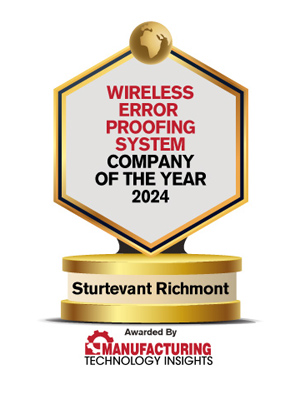
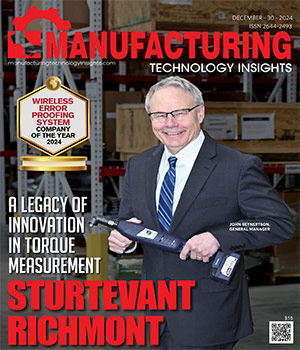
Sturtevant Richmont has redefined the torque measurement industry for nearly a century, blending precision, durability and innovation into its products. Guided by John Reynertson’s leadership, the company has built on a history marked by groundbreaking advancements and a commitment to error-proofing systems that enhance manufacturing processes. Torque control devices are crucial in securing parts together, even in the face of vibration and external forces. These tools help ensure that fasteners are applied with the correct force, maintaining the assembly’s integrity. However, while torque measurement can confirm that a fastener has been tightened properly, it cannot detect all errors. Issues such as missing bolts or cross-threading can only be noticed with additional systems monitoring the assembly process. This is where Sturtevant Richmont’s comprehensive approach to error-proofing becomes invaluable. It provides solutions to detect such errors and guides operators to resolve them. Design, Detection and Operator Guidance: The Core of Error Proofing Sturtevant Richmont’s error-proofing strategy begins with designing tools that minimize the chance of mistakes right from the start. A prime example is their torque wrenches with interchangeable heads, which maintain calibration accuracy even when the heads are swapped. This thoughtful design prevents errors caused by improper calibration—an issue common in many other systems. In addition, advanced technologies, like the shear beam sensor technology in tools such as the Exacta 1350 TD Series Digital Torque and Angle Screwdrivers, boost sensitivity for more precise torque application. Equally important is error detection, which plays a critical role in Sturtevant Richmont’s approach. Tools like the Global 400 Series Torque Controller System provide immediate feedback to operators, alerting them when a mistake occurs. This prevents errors from moving down the production line and allows operators to correct the issue before any defects are created. The system uses clear visual and auditory signals, making it easy for operators to identify problems and resolve them quickly. Operator guidance is another cornerstone of Sturtevant Richmont’s system. The tools notify operators when an issue arises and guide them on how to fix it. This feature ensures that mistakes are addressed swiftly without slowing down the assembly process. Sturtevant Richmont helps keep production running smoothly and accurately, ensuring the assembly process stays error-free by walking operators through troubleshooting steps. “Our clients are often surprised by the significant savings realized once our control systems are integrated into their production lines,” says John Reynertson, General Manager. Error proofing offers several tangible benefits, including improved manufacturing efficiency and significant cost savings. Immediate error detection allows production to continue at full speed without compromising accuracy. With fewer errors and the ability to address mistakes as they arise, manufacturers save on rework costs and prevent defects from progressing through production. Additionally, by preventing defects in the first place, companies can avoid costly warranty claims and ensure product quality. Many of Sturtevant Richmont’s clients experience a return on investment within the first year, thanks to the reduced downtime and increased operational efficiency these error-proofing systems provide.
Smart Factory

Ramon E. Gonzalez, SVP Operations & Supply Chain, Americas, Nilfisk
Motion Control Systems

Dale Mark, Vice President of Manufacturing Operations, Mitsubishi Logisnext Americas
Precision Machining

Jon Urquhart, Director Global Applications Engineering, PVA
Edge Computing

Terrance H. Slaughter, Plant Production Manager, Toyota North America
Manufacturing ERP

Thiago Jube, Process Technology Manager, Barry Callebaut Group

Industrial AI
Dashiell Sklenar, Product Manager - Generative AI, Weyerhaeuser
Industrial Automation
Larry Saidman, Chief Technologist - R&D, Nordson Corporation
AI in manufacturing boosts efficiency, quality control, predictive maintenance, supply chain optimization, automation, and worker safety, transforming production processes.
Wireless Error Proofing Systems have become an essential component in modern manufacturing and production environments.
The Rise of Wireless Error Proofing Systems
Error proofing, or “poka-yoke,” has long been a cornerstone of quality management. Traditionally, these systems relied on hardwired setups to detect and prevent errors in manufacturing processes. However, the advent of wireless technology has revolutionized this space, introducing flexibility, scalability, and cost-effectiveness to error-proofing strategies.
Wireless error-proofing systems integrate sensors, connected devices, and advanced software to monitor production activities in real-time. They identify potential issues before they escalate, guiding operators through corrective actions and ensuring errors are rectified immediately. These systems can be seamlessly incorporated into existing manufacturing processes without the constraints of physical wiring, making them particularly advantageous in dynamic and expansive production environments.
The evolution of wireless error proofing systems is set to accelerate with advancements in 5G, AI, and machine learning. These technologies promise to enhance the precision, speed, and intelligence of error proofing mechanisms. Furthermore, as sustainability becomes a focal point, wireless solutions will play a key role in reducing waste, conserving energy, and minimizing rework.
Wireless error proofing systems are not merely tools but enablers of transformative change in manufacturing. By reducing errors, optimizing workflows, and fostering innovation, these systems position manufacturers to meet the challenges of an increasingly competitive and complex global market. As adoption continues to grow, the synergy between wireless technology and manufacturing excellence will only deepen, heralding a new era of industrial efficiency and quality.
In this edition, we have featured Sturtevant Richmont. The company’s error-proofing strategy begins with designing tools that minimize the chance of mistakes right from the start. A prime example is their torque wrenches with interchangeable heads, which maintain calibration accuracy even when the heads are swapped.

Manufacturing Technology Insights Weekly Brief
Be first to read the latest tech news, Industry Leader's Insights, and CIO interviews of medium and large enterprises exclusively from Manufacturing Technology Insights
