


THANK YOU FOR SUBSCRIBING


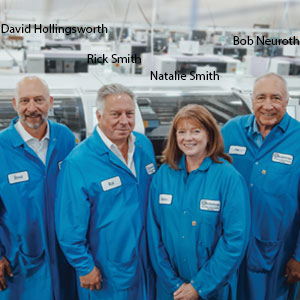 David Hollingsworth, Co-Founder & VP, Business Development, Rick Smith, Co-Founder & President, Natalie Smith, CEO & HR Manager and Bob Neuroth, Head, Materials Management
It’s 2000, and all the momentum built up by MTS comes to a screeching halt as the dotcom bust forces the world’s largest companies to offshore their manufacturing operations.
It’s 2001; a majority of America’s electronic companies are in free fall—factories across the nation shed thousands of jobs and shut down factories. Two of MTS’ largest customers cease to exist, and two others move their production offshore. Within 180 days, the company’s sales plummet by 80 percent. The writing is on the wall, MTS is on the brink of bankruptcy.
It’s 2002, and the EMS industry in the U.S. is continuing to fall. On Tuesday January 8th, David Hollingsworth, director of sales at MTS, arrives at the factory—in White City, Oregon—to find that everyone including Rick Smith, the president of MTS, is fired, and the owners are preparing for the inevitable. “That night several ex-employees got together and had a few too many beers and hatched an idea to save the factory,” recalls Hollingsworth. On Friday January 11th, after three long days and “a few more beers,” Hollingsworth and Smith agree to purchase most of the assets of MTS and Ascentron is born.
It’s 2019. Ascentron is ITAR Registered and a prominent player in the military industry, providing manufacturing services for three of the largest defense contractors in the country: Collins Aerospace, Lockheed Martin, and L3Harris Technologies. However, the road taken to attain manufacturing excellence across industries such as aviation, medical products, instrumentation, and military, has been paved by a checkered path—filled with hurdles, turning points, and tales of redemption.
Reassessing Capabilities to Reinvent the Business
Now, to pivot back to January of 2002, when Ascentron refused to wave the white flag even as major factories across Oregon—owned by Solectron, Epson, Fujitsu, Hewlett Packard, and Tektronix—closed their doors.
With a handful of employees—28 to be exact—and leftover customers, Ascentron was open for business, albeit without a concrete plan in place. As a majority of high volume manufacturers moved offshore, Ascentron decided to shift its focus from high volume price-sensitive customers to medium-to-low volume customers that required responsive services and optimum quality. Though 80 percent of Ascentron’s business continued to come in from computer, consumer goods, automotive, and communications, the EMS provider identified industries such as aviation, medical, instrumentation, industrial, and military as their target customers of the future. “We knew going forward that our target customers would need high-level technical capabilities, great customer service, and would want us to be located close by here in America.” says Hollingsworth, co-founder and VP Business Development of Ascentron.
Soon after its rebirth, Ascentron was determined to transition a lion share of its manufacturing to the aforementioned target industries. In this pursuit to reinvent its business, Ascentron ramped up its efforts to hire the best employees that were available. As fate would have it, the dotcom bust left a lot of talented people out of work. “Within our first few years, we hired a new operations manager, materials manager, engineering manager, and quality manager that hailed from large companies such as General Dynamics, Plexus, Tektronix, and Tyco Electronics,” informs Smith, the co-founder and president of Ascentron.

A prominent military company could easily adopt a large contract manufacturer. However, they don’t receive the attention and quality service that we can deliver
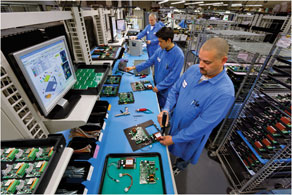 Importantly, Ascentron succeeded in reinventing its business. Today, its clients are spread across the sectors that Hollingsworth and Smith targeted in 2002: aviation (35 percent), medical products (35 percent), instrumentation (10 percent), and military (10 percent). “When we started (in 2002), we didn’t have a single medical or military customer. We’ve achieved this turnaround due to our investments in training, quality protocols, continuous improvement programs, and state-of-the-art technology,” says Hollingsworth, credited with building a sales team that fast-tracked Ascentron’s sales 500 percent from $4mn in 2002 to $20mn in 2008.
Building up Cash Reserves to Rebuild Factory
While investing in people, and training them adequately, has been a linchpin in Ascentron’s remarkable turnaround, the EMS provider has survived and thrived due to another critical business decision. During its foundational years, in 2002, the company was admittedly “very tight on cash” and realized that cash management and accumulation of cash reserves were critical.
Re-building the factory with state-of-the-art equipment was another hurdle in Ascentron’s path to success. Be it material-handling equipment, or high-tech workbenches for the factory floor, Ascentron needed tools aplenty to fill its bare cupboard. Hollingsworth recounts, “We prioritized what we needed most, followed by what we should buy new and what we could buy used.”
After purchasing a new x-ray inspection machine, to keep pace with the industry, Ascentron gradually accumulated material-handling equipment and high-tech workbenches from other factories that had closed down across the country—at 10 to 20 cents on the dollar. “We utilized the cash reserves we were building,” adds Hollingsworth. Over the next five years (2002-07), Ascentron would gradually add automated optical inspection equipment and other production equipment to its arsenal of tools.
The Tools, Technologies, and Services
From purchasing used equipment through discarded factories to building a full brain scanning system for Philips Healthcare, and an ultrasonic medical device for a company in Tokyo, Ascentron has come a long way over the last two decades. Today, Ascentron’s factory comprises of a litany of state-of-the-art technologies and tools such as the latest Panasonic Surface Mount Technology (SMT) pick and place equipment, three in-line Koh Young 3D Automated Optical Inspection machines, and complex Box Build capabilities.
Besides possessing the capability to provide turnkey Box Build solutions for customers in the aviation, medical, instrumentation, and industrial sectors, Ascentron offers complete testing services featuring an SPEA flying probe tester, Checksum MDA (bed-of-nails), functional, and ESS testing.
Meanwhile, Ascentron’s engineering support group provides design-for-manufacturability (DFM) services to help lower costs and increase manufacturing efficiencies.
By leveraging these tools and technologies, Ascentron offers a wide range of services such as SMT & Through- Hole PCB Assembly, RoHS Compliant Manufacturing, Prototype, and New Product Introduction. Ascentron also delivers services for special processes such as Conformal Coating and Potting, Components Mounted on Flex Circuits, Part on Part (PoP)—BGA mounted on BGA, and an In- House Machine Shop for Tooling and Fixtures.
Responsive and Customer-Centric
When an OEM outsources its manufacturing operations to an EMS provider, it essentially relies upon an entire factory to support its manufacturing requirement. Ascentron acknowledges the same and takes the onus upon itself to deliver top-notch customer service. “In the EMS business, you don’t buy something off-the-shelf. There is so much coordination and back-and-forth involved. While trying to get them (a client) out of a jam, we also need to be responsive to their needs,” explains Bob Neuroth, the materials management expert at Ascentron.
"We’ve achieved this turnaround due to our investments in training, quality protocols, continuous improvement programs, and state-of-the-art technology"
To constantly improve its customer service, Ascentron had two Program Managers complete the IPC-certified EMS Program Managers training (2 out of approximately 150 in the country) and is on the brink of getting another two Program Managers trained and certified by the IPC.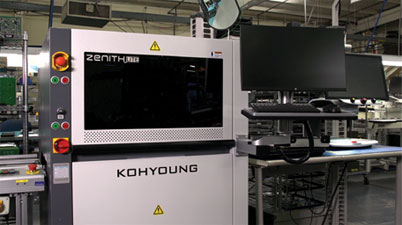 On the quality front, Ascentron’s systems are already AS9100D, ISO 13485:2003 and ISO 9001:2015 certified, but the EMS provider isn’t resting on its laurels. As part of its continuous improvement process, Ascentron intends to constantly enhance its quality protocols.
Looking ahead, Ascentron will make further inroads into the military industry. Despite first starting to pursue the industry in 2010, Ascentron has made rapid strides supporting the manufacturing needs of defense contractors. A few years back, Ascentron built a rugged, handheld military computer for a large client. They now support technology used in drones manufactured by another large defense company. “Despite being a large company, they had a small volume requirement, a perfect project for us,” says Smith.
Such success stories only encourage Ascentron to continue focusing on medium-to-low volume manufacturing projects, a model perfectly suited for both the OEM and Ascentron. Smith explains, “A prominent military company—such as our client, Lockheed Martin—could easily adopt a large contract manufacturer. However, they don’t receive the attention and quality service that a smaller EMS provider like us can deliver. It’s a perfect situation for both of us.”
In conclusion, Ascentron is battle-tested to face impending market downturns, if any. Having bounced back from the 2002 EMS collapse, and the 2008 Great Recession—when the company’s sales dropped from $20Mn to $10Mn before rebounding—Ascentron is equipped to counter every challenge. In fact, it has the proven track record of converting a market slump into an opportunity. For example, in 2008, Ascentron pounced on the opening to enter the medical devices industry after the Great Recession forced a large industrial manufacturer to close down. Hollingsworth recalls, “When we noticed this company going down in the industrial industry, we accelerated our efforts to get ISO 13485 certified. That decision allowed us to better pursue the medical devices business.”
Today, medical companies comprise 35 percent of Ascentron’s clientele. “We truly believe that every crisis presents an opportunity,” concludes Hollingsworth.

Company
Ascentron Electronic Manufacturing
Management
David Hollingsworth, Co-Founder & VP, Business Development, Rick Smith, Co-Founder & President, Natalie Smith, CEO & HR Manager and Bob Neuroth, Head, Materials Management
Description
An electronics manufacturing services (EMS) company that provides manufacturing services to aviation, medical, military, and industrial customers with low-to-medium volume projects. One of the top defense manufacturing solution providers, Ascentron is an ITAR Registered company that provides manufacturing services for three of the largest defense contractors in the country: Collins Aerospace, Lockheed Martin, and L3Harris Technologies. Ascentron’s services include SMT & Through-Hole PCB Assembly, RoHS Compliant Manufacturing, Prototype, and New Product Introduction. Ascentron also delivers services for special processes such as Conformal Coating and Potting, Components Mounted on Flex Circuits, and Part on Part (PoP)—BGA mounted on BGA

Manufacturing Technology Insights Weekly Brief
Be first to read the latest tech news, Industry Leader's Insights, and CIO interviews of medium and large enterprises exclusively from Manufacturing Technology Insights
