

THANK YOU FOR SUBSCRIBING
A featured contribution from Leadership Perspectives: a curated forum reserved for leaders nominated by our subscribers and vetted by our Manufacturing Technology Insights Advisory Board.

Business Process Management (BPM) in Industry is essential for the systematic creation, analysis, validation and enhancement of processes, with the primary goals of increasing efficiency, reducing costs and improving decision-making. In the manufacturing context, processes face specific challenges, such as production line flexibility.
The modularity of the production line enables its flexibility, expanding the potential for its optimization. Each production module has its own characteristics that must be taken into account when designing a comprehensive production line that combine multiple modules. The current approach uses digital twins for each production module, to represent operational metrics and enable advanced functionalities, such as complex AI-based simulations, predictions and optimizations. Our objective is to integrate these individual digital twins into a digital representation of the overall production process.
The EU-funded project MODAPTO1 (Modular Manufacturing and Distributed Control via Interoperable Digital Twins) has developed a set of technologies that combine modular production systems with interoperable Digital Twins (DTs) to apply AI-based services.
The Business Process Modelling Notation (BPMN) represents the production process and describes the connection to the various digital twins of individual modules using the standardized Asset Administration Shell (AAS) representation.
BOC2 has adapted its product ADONIS3 , which is recommended by Gartner's 2025 Voice of the Customer report4 , to integrate AAS and elaborates the usage of BPMN in combination with AAS to manage the digital twins of a production line, in the context of MODAPTO. ADONIS is a fully web-based business process management suite that is capable to extend the BPMN representation with production-relevant methods and artifacts. ADONIS has been extended with digital twin concepts to offer a management suite that provides quality-assured versioning, release and approval of AAS-compliant digital twins within the context of a production process represented in BPMN.
Each digital twin can expose AI-based services such as predictive maintenance, optimization or simulation, which are tailored for the specific production module. To orchestrate these services for the overall production process, we extend the business process modeling notation (BPMN) with connectivity concepts that allow the description and deployment of connections between AAS-based digital twins and services that provide the requested functionality. When applying AI-based services, the MCP approach can be used to facilitate data exchange between the modelled digital twins and the connected AI-based services.
A demonstration of AI-based service connectivity to AAS-based digital twins is provided in MODAPTO by the Virtual Commissioning scenario. Before starting the operation of a production process, it is essential to validate the correctness and efficiency of the entire line as well as each individual module. Virtual Commissioning is an approach that uses digital twins and simulations to validate and optimize each module before they are executed in the shopfloor. This supports designers and planners in making informed decisions about the integration of new production modules into existing production lines without the need for their physical presence.
In MODAPTO, the virtual commissioning solution of EKS, RF::SUITE5 , has been extended and integrated using the AAS representation for digital twins. RF::SUITE applies simulation logic of various formats, including Ladder Logic and Functional Mock-Up Unit (FMU) and can interface with real control logic, such as a programmable logic controller (PLC), to simulate system’s operation and response. This integration enables the continuous simulation of the production process with near real-time performance.
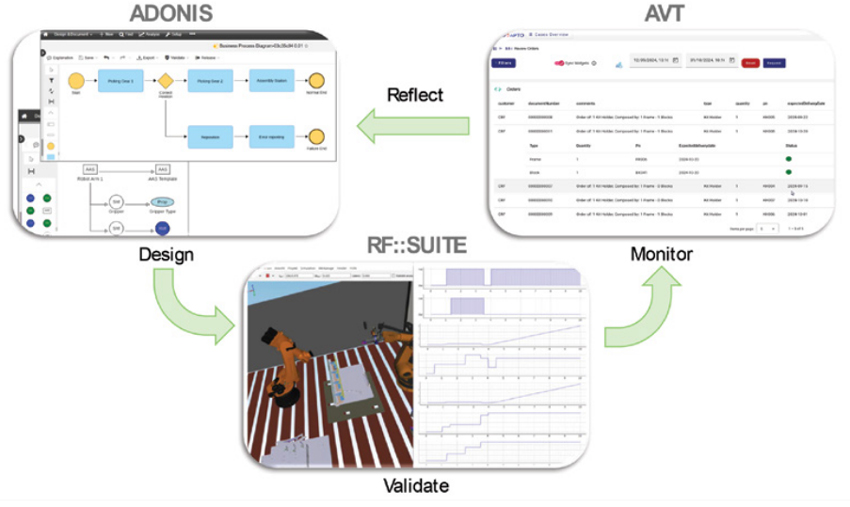 The production process is evaluated by monitoring the execution and comparing the behavior with the designed and simulated results. This enables a short-term reaction through the early identification of unforeseen issues, as well as midterm improvements in the redesign and reconfiguration of the process.
The AEGIS advanced visualization Toolkit6 has been used and integrated to deliver a customized evaluation and decision support system for the management of the production process. The result is a comprehensive cockpit that offers intuitive visualizations, service invocation forms, multi-purpose dashboards, timeline inspections and preconfigured views. These features facilitate the effective evaluation of metrics, monitored in production modules and outputs of the different service executions, revealing hidden relationships and insights within heterogeneous data sets. The component supports IT and non-IT domain experts in decision-making, providing valuable insights into the efficiency and effectiveness of their production operations.
BOC integrated the business process management toolkit ADONIS, the virtual commissioning environment RF::SUITE and the advanced visualization toolkit into a business process-based management environment capable of using AI-based services for the design, simulation and monitoring of the production process, providing support in decision-making.
In the context of the MODAPTO project, the prototypical implementation integrating all the presented functionalities, is called Modular Production Toolkit7 . This toolkit relies and interacts with all the other main components of MODAPTO, like the engine to deploy and operate the AAS-based digital twins (DT manager), the production knowledge base and the different services for co-simulation, co-optimization, sustainability analytics, predictive maintenance and self-awareness.
This integration has been conceptually realized by leveraging ADONIS's Meta-Model technology, which enables the extension of BPMN with connections to AAS-based digital twins and corresponding AI-based services. It was technically implemented by applying a Microservice Connectivity Framework, which enabled the information exchange between services and ADONIS.
This integrated solution facilitates the creation of correct and optimized digital twins for modular production and improves overall production processes.

Manufacturing Technology Insights Weekly Brief
Be first to read the latest tech news, Industry Leader's Insights, and CIO interviews of medium and large enterprises exclusively from Manufacturing Technology Insights
