

THANK YOU FOR SUBSCRIBING
A featured contribution from Leadership Perspectives: a curated forum reserved for leaders nominated by our subscribers and vetted by our Manufacturing Technology Insights Advisory Board.

As Director of Advanced Technology at STERIS, Kevin McCauley has more than 15 years of leadership across industries. He brings deep technical expertise with 32 patents and 10 publications, alongside a sharp focus on commercial outcomes. His career spans everything from small molecule synthesis to polymer development and FDAregulated product launches. Yet, his ability to build cohesive, high-performing teams and strategic R&D pipelines sets him apart. At STERIS, McCauley leads the Advanced Materials function across diverse verticals—from sterilization and surgical consumables to packaging and metal processing.
 Engineering Innovation Where Materials Meet Strategy
Throughout his career, McCauley has seen how materials science can quietly define the pace and potential of innovation in healthcare, not through high-profile product launches alone, but through what happens far earlier in the process. The choices made in sourcing, processing and integrating materials set the tone for everything that follows. When those systems lag, so does innovation. When they align, entire industries shift forward.
He has built his career around this principle. Materials are not just technical components. They are levers of value, especially in sectors where safety, speed and regulatory precision shape every decision. His work sits at the intersection of chemistry and commercial execution, focused on turning that complexity into momentum.
Building Scalable Platforms from the Ground Up
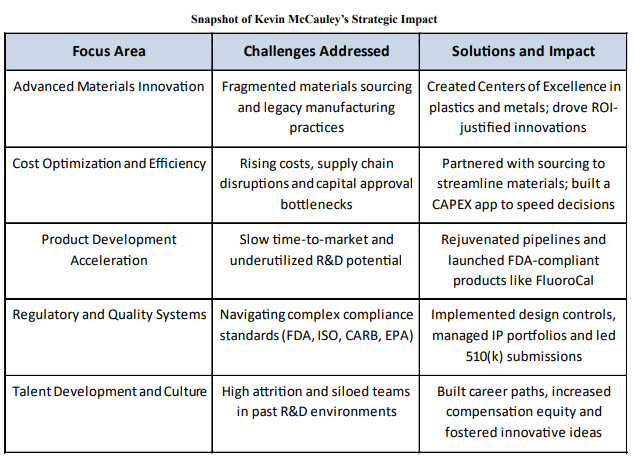
Many companies approach materials as a constraint to work around. McCauley takes a different view. He sees inefficiencies in sourcing and processing as an opportunity to engineer stronger foundations. That mindset led to the creation of Centers of Excellence, which focused on plastic molding and steel finishing. These were not just operational upgrades. They were strategic platforms built to support scalable innovation, enhance product quality and unlock manufacturing potential across the organization.
“McCauley believes science must serve more than progress. It must serve people. His involvement in nonprofit leadership reflects that belief. It extends his work beyond commercial labs and into the community, where the same principles apply”
What he learned through this process was clear. Value does not emerge from the materials themselves. It comes from building environments where those materials can perform at their highest level, consistently and at scale.
Designing With Constraints, Not Against Them
In regulated industries, compliance is often treated as a hurdle. McCauley sees it as an essential design input. His approach integrates standards like ISO 13485 and FDA 21 CFR Part 820 into the earliest stages of development. That integration creates a different kind of innovation—one that does not sprint ahead only to pause at the finish line. Instead, it moves deliberately and predictably without sacrificing speed or scientific integrity. This was evident during his time at BISCO, where he led the launch of FluoroCal, a fluoride and calcium-releasing varnish that reached nearly one million dollars in first-year sales. The success was not just technical. It was cultural. The team operated on trust, clarity and shared ownership, resulting in commercial impact and an exceptionally low attrition rate.
Leading With Chemistry and Clarity
McCauley’s foundation in organic chemistry gave him the analytical depth to tackle complex technical challenges. But what shaped his leadership was something broader. He learned to translate molecular insights into strategic direction. That ability has made him a connector across R&D, operations and sourcing. He can identify where science is going and what businesses must do to keep up. His leadership reflects that exact alignment. He mentors early-career scientists with the same care he brings to capital strategy. He has implemented digital tools to improve project approvals and led Lean boot camps to increase flexibility on the manufacturing floor. In every case, the goal remains the same. To bring discipline and adaptability into harmony, turning good science into systems that perform.
A Broader View of Impact
McCauley believes science must serve more than progress. It must serve people. His involvement in nonprofit leadership reflects that belief. It extends his work beyond commercial labs and into the community, where the same principles apply. Innovation can benefit both business and society when driven by purpose and shared accountability.
He continues to pursue not just better products but also a better way to work with materials, teams and systems—one that withstands regulation, scales with complexity and moves innovation forward with confidence and care.

Manufacturing Technology Insights Weekly Brief
Be first to read the latest tech news, Industry Leader's Insights, and CIO interviews of medium and large enterprises exclusively from Manufacturing Technology Insights
