

THANK YOU FOR SUBSCRIBING
A featured contribution from Leadership Perspectives: a curated forum reserved for leaders nominated by our subscribers and vetted by our Manufacturing Technology Insights Advisory Board.


Today’s digital factories are occupied by robots and are run by automation software that receive real-time updates from the production floor via Internet of Things (IoT) sensors. During COVID-19, Industry 4.0, the term used to include all the technologies enabling digital manufacturing, proved its value by enabling organizations to run production during the pandemic. Per a Mckinsey survey of 400 global manufacturers, 94percent of respondents indicated Industry 4.0 had helped them keep their operations running during the crisis, and 56 percent said these technologies had been critical to their crisis responses..
There will be future crisis that will affect operations thus firms are heavily investing in Industry 4.0. A 2020 Gartner Smart Manufacturing survey shows
• 86 percent of respondentsstate digital manufacturing is an integral component of their digital supply chain strategy
• 84 percent agree they expect digital manufacturing to increase their competitiveness
Like other technology led disruptions, digital manufacturing success is dependent on the people affected by the change, the enhanced processesthat are enabledand the underlying technologies. In 2022, there are numerous examples of “best practices” associated with Industry 4.0. Specifically, templates that document how firms have successfully deployed Industry 4.0 technologies as well as implementation providers with proven solutions are readily available.
The human side of technology, from my experience, is the key criteria that needs to be addressed. I’ve led Industry 4.0 implementations that did not deliver the return on investment (ROI). It was not the technology or the processes that caused the missed ROI, it was the people. Specifically, the people affected by the new technologies agreed the digital solutions would benefit not only their daily jobs, but also improve overall factory production. The issue was we did not correctly upskill the employees to effectively use the new technologies and enhanced processes.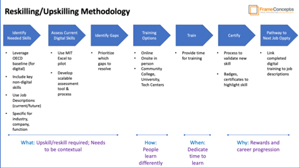
As a lesson learned, every Industry 4.0 initiative since the missed ROI, I’ve ensured upskilling is a priority. It’s been challenging since the current mindset is to focus on the process changes and the technologies. Training was an afterthought. The mindset of “build it and they will use it” is false and an expensive assumption.
I’ve had an opportunity to work with other Fortune 100 organizations to address the digital upskilling challenge and we’ve co-developed the below methodology:
“Technology and the enhanced processes enabled by Industry 4.0 will not be the reason for missed ROI, it will be not upskilling employees to benefit from the new digital solutions”
The methodology focuses on the What/How/When/Why associated with upskilling.
The “What”:
First question to answer is: what skills need to be upskilled? The skills you require will be particular to your firm’s needs. For example, a factory full of robots will require different training versus that of a manufacturing site that recently deployed a Manufacturing Execution System (MES). Best practice is to leverage baseline digital skills assessments and modify them to your needs. I’ve found the OECD digital skills assessment results as a good baseline digital skills assessments and modify them to your needs. I’ve found the OECD digital skills assessment results as a good baseline. https:// goingdigital.oecd.org/theme/4
Working with other global manufacturing firms, we’ve identified the below skills as key to successfully working in a digital factory:
• Software skills
• Digital device operations
• Web/Internet/Intranet capabilities
• Presentation skills
• Communication skills
• File management skills
Develop a process to assess your employees in the critical skills and identify gaps in competency. From experience, there will be a wide range of gaps. Therefore, prioritize to manage expectations and to scope a viable training plan.
The “How”:
Standard practice for factory skills training is to have dedicated training workshops. Specifically, a few hours allocated for workers to listen to presentations on the new skill. Today, this education model does not work. People vary on how they learn. Some people prefer online training, others enjoy reading manuals and some thrive in classroom environments. For digital skills, people want to “touch and engage” with the technology. Employees desire a safe environment to “break” the technology without affecting production. This enables workers to get comfortable using the technology as they learn by doing and breaking.Assess how your employees prefer to learn and ensure options are available.
The “When”:
During COVID-19, factories that were operating were manufacturing 24/7. In addition to working overtime, employees were asked to learn new Industry 4.0 skills. No surprise, workers were not proactively upskilling outside of work. Even in today’s environment, justifying dedicated time for upskilling is challenging. Digital upskilling requires more frequent time allocations. Employees need time to learn the new skill, practice it and follow up time to redo skills that they did incorrectly. A method that has shown success is “30 min trainings”. For example, on Monday a 30-min session is provided to introduce a new skill. Throughout the week, employees are allocated 30-min sessions where they can practice the new skill in a safe environment (a non-production workspace with experts available to assist).
The “Why”:
Advising employees that upskilling is required for their current job tasks does not provide the motivation for full engagement. However, partnering with workers to identify how completing digital upskilling would enable career progression does provide the right nudge. Additionally, by providing badges- virtual badge on their online company profile and a physical badge that can be worn- to employees who completed training certifications, we noticed not only an increase in upskilling activities, but also pride. Employees related the expertise recognition as a badge of honor. The insignia also enabled other, less trained employees to identify people who could help them with the new technologies.
Digital manufacturing is no longer a future endeavor. Its benefits were proven during COVID-19 and firms are accelerating its deployment. Technology and the enhanced processes enabled by Industry 4.0 will not be the reason for missed ROI, it will be not upskilling employees to benefit from the new digital solutions. To successfully upskill factory employees, ensure workers understand the why, what, how and when associated with gaining the digital skills.
There is no silver bullet to digital upskilling and collaboration is key to ensuring everyone benefits. Please connect with me via LinkedIn (https://www.linkedin.com/ in/hndinh/) so we can share our experiences and learn together.

Manufacturing Technology Insights Weekly Brief
Be first to read the latest tech news, Industry Leader's Insights, and CIO interviews of medium and large enterprises exclusively from Manufacturing Technology Insights
