

THANK YOU FOR SUBSCRIBING
A featured contribution from Leadership Perspectives: a curated forum reserved for leaders nominated by our subscribers and vetted by our Manufacturing Technology Insights Advisory Board.


Scaling production is one of the hardest challenges in aerospace manufacturing. Moving from prototype to production—or from dozens of units to hundreds—often exposes effects of process failure modes and inefficiencies that weren’t visible at smaller scales. Real life is messy: equipment layouts, people flow, logistics, and quality control all interact in complex ways. Decisions about equipment capital expenditure, floor space, and staffing must be made with confidence, yet that confidence is often undermined by significant uncertainty. This is where factory simulation becomes the key to scaling.
We use commercially available software to create a digital manufacturing environment. This provides a powerful solution for bridging the gap between conceptual factory planning and physical reality. Imagine combining the analytical rigor of an Excel spreadsheet with the spatial intelligence of a 3D factory layout—then adding the ability to run countless “what-if” scenarios that mirror how real production behaves. Using commercially available software we now have: a way to simulate, test, and refine factory design decisions before concrete is poured, machines are purchased, a production area is re-organized or operators are hired and trained.
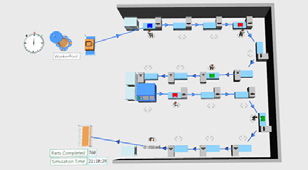 Figure 1 Factory Digital Twin At its core, factory simulation allows engineers and manufacturing planners to build a digital twin of the production system. Each machine, work bench and workstation is represented as an object with real operating parameters: cycle time, uptime, changeover duration, and availability. These digital assets are connected through logical and spatial relationships—how parts move, where buffers form, and when bottlenecks occur. Each product and each operator is also represented with their skills and shift pattern. Once modeled, the system can be simulated under a range of demand and staffing conditions. Specific failure cases such as equipment or process problems can be injected. The result is a much-improved understanding of throughput, utilization, and productivity long before the first operator arrives on the shop floor.
“Industrialization will always be hard, but with a digital twin, it becomes a manageable problem rather than a leap of faith.”
This capability turns speculation into strategy. “What happens if we add a second inspection cell?” “What’s the ROI of automating material transfer?” “Can we meet the 200-unit-per-month target without adding shifts?” Each of these questions can be tested virtually. The output isn’t just numbers—it’s a dynamic animation showing parts flowing through the line, operators moving between stations, and queues forming in real time. Managers can see bottlenecks emerge, engineers can validate capacity models, and finance teams can support capital decisions with greater confidence.
We use these tools beyond the screen by exporting layouts for 3D printing, creating tangible scale models of proposed factories. This physical representation helps communicate complex ideas to stakeholders— executives, customers, and suppliers alike. It’s much easier to explain a new production concept when everyone can point to a miniature layout and visualize how material moves from machining to final assembly. For aerospace, where industrialization programs can involve millions in tooling and years of lead time, that shared understanding is invaluable.
Figure 2 3D Printed Factory Simulation Model
 Ultimately, factory simulation helps organizations move faster with less risk. It reduces the guesswork inherent in scaling, allowing teams to test alternatives, validate assumptions, and optimize both cost and performance before committing resources. Industrialization will always be hard, but with a digital twin, it becomes a manageable problem rather than a leap of faith. At Moog Inc., in an industry defined by precision and reliability, we are doing more factory simulation than ever before and this is providing the confidence needed to scale successfully.

Manufacturing Technology Insights Weekly Brief
Be first to read the latest tech news, Industry Leader's Insights, and CIO interviews of medium and large enterprises exclusively from Manufacturing Technology Insights
