

THANK YOU FOR SUBSCRIBING
A featured contribution from Leadership Perspectives: a curated forum reserved for leaders nominated by our subscribers and vetted by our Manufacturing Technology Insights Advisory Board.

Here is a bit of storytelling to help connect why what we are about to discuss matters. For our story, we’ll use science fiction as the reference. Some sci-fi buffs may recall in 2011, Bradley Cooper starred in a movie called LIMITLESS. In the movie, Cooper who plays a self-made loser takes an experimental drug that allows him to use 100percent of his mind. He suddenly can recall everything he has ever heard, seen, or learned and combine that with all the new things his brain can consume. This instantly enables him to have access to all his knowledge combined with the ability to make complex analyses and decisions. However, it is still at the maximum speed and capability of biology, he is not a computer. The movie’s version of a human and a digital all in one person.Superhuman invincibility in a bottle.
Nearly all industrial companies are on a journey of some type of IoT/Data inspired “transformation”.Many traditionallycall it Digital Transformation when they first start. Others who are already seeing lots of valueevolve tocalling it nothing at all, asthey have completely altered how they get things done and continue to rethink themselves going forward.Most companies do not stop to think about how they can transform across the enterprise in a system-wide approach – they do it in silos which create upstream and downstream consequences.
For the rest,who are still hoping and looking for insightsthere are a myriad of companies offering plenty ofassistance and/orsolutions, for a price. Unfortunately, it is exactly in those cascading multitudeswherethe noise for us end-users can,at times, be deafening. So perhaps it may be time for us toput away our phones and email or if you are like me with dog-years of experience, turn down thehearing aids and get back to the basics of problem-solving.
To begin with, perhapswe have a systems problem. One is of the human, one is of the digital.Our approach has been to entangle the two even though they have dramatic dimensional differences (linearversus exponential). For simplicity, let’s call one the Human Enterprise (HE), and we’ll call the other the Digital Enterprise (DE). They each have domainelements that we use to drive value creation, and fit the way we thought things should be done, and therefore connected.
“Data is growing exponentially, and our enterprise’s ability to capture value does not match the rate at which data is being created”
The two entangled systems are as follows with common domains highlighted:
• Human Enterprise (HE) Cycle: more success, leadership confidence, more investment, better talent, and greater need to prioritize value. The HE contains the knowledge of the enterprise, but its speed is limited by human effectiveness.
• Digital Enterprise (DE) Cycle: more success, leadership confidence, more investment, more data & complexity, and data science. The DE enables accelerated data capability and speed to the organization but lacks the context and depth of knowledge contained in the HE.
In reality, we probably wouldn’t have ever suspected that we created a systems problemexcept for the data. Data, as it turns out, is the realculprit.Imagining these two systems as cycles in the way that we constructed them to fit our enterprise may appear similar to Figure 1 below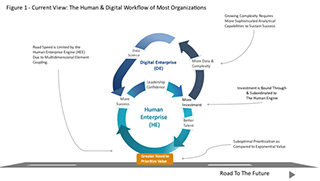
In Figure 1, we can seethat the two systems intersect forming two linked cycles that drive us forward on the road to the future.Then, it also follows that our pace forward on the road to the future is set through human-poweredinstitutionalfunctions and processesin the HE domains (i.e., More Success, Better Talent, Leadership Confidence). What is interesting when we draw the picture this way is how we have theDigital Enterprise contortedtofit the human.This means that regardless of the potential advantage that digital imbues it has to conform to the institutional of thehuman.And isfurther limited in speed due to itslongentanglement with the Human Enterprise.
In short, by not knowing any better,we pasted Digital on top of ourHuman Enterprisecreatingmassive entanglement and complexity problems. These are the problems that we face every day in the form of Technical Debt and Customer Dissatisfaction.
Now that we know the problems we are facing, how might we solve them? How about:
A. Get the human off of the road
B. Create value at parity with the growth of data.
C. Minimalize the entanglements between the systems.
D. Next, let’s look at an alternative combination of cycles that satisfies the above conditions (Figure 2).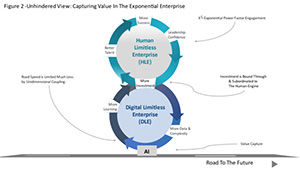
Suppose we take the DE and supercharge its capabilities by disentangling itfrom the HEwhere their only connection becomes“More Investment” in either talent or technologyand further advancing “data science” to become“AI”.This new digital cycle is now only linked to the “road to the future” by itself and is free to become the Digital Limitless Enterprise (DLE). Its components are now: AI, more success, more investment, and more data & complexity.Interestingly,because it is now unburdened from connection to the road,the former HE now transforms and becomes theHuman Limitless Enterprise (HLE), andis free to act in a new way, as a power factor through talent by adding momentum to the DLE through“more investment”.Freeing up humans to apply knowledge in a way that further alters the entire enterprise from not just “Exponential”, i.e., capturing value at the rate that data grows, to what leading AI expert Arthur Kordon calls“Super-Exponential”. Capturing value at the rate that knowledge grows. See figure 3.
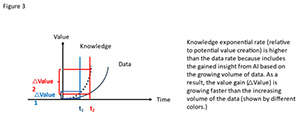 Now that we have a potential solution, how do we make all of this happen? It’s called changing our Frame-of-Reference. Part of changing our reference is understanding Fig. 3, which is the difference between what we are already doing, and what we need to be doing from an outcome perspective.
Making this changeis a lessonwe must all learn and experience to believe and understand. Therefore, paying others to teach us might be less fruitful than we hope. This is why turning down myhearing aids was so important.
Nothing matters more than your contextin building a new frame of reference. Interestingly, the frame of reference begins again with an acknowledgmentof the culprit. Data is growing exponentially, and our enterprise’sability tocapture value does not match the rate at which data is being created. Therefore, we are sub-optimized and that gap continues to grow.
In his book titled The Exponential Age,investor& author, AzeemAzharadvocates that to not usethese readily availabletechnologies and abundantly generated data, disadvantages a company and in time will make it uncompetitive.
Perhaps yourcompany’s experiencein the real-life Exponential Age is also being defined bytechnology and the exponentially growing data it creates.Now consider arranging your supercharged DLE along with a power factored HLE where human knowledge capture andthe human network effectare now enabled by that technology. Your entire industry, all its supply chain and enterprises,functions, and processes can be taught to a machine and combined into one connected knowledge domain and integrated with causal reasoning and decisions. These capabilitiesinreal-time, can be and have been successfully assembled through methodologies to create“Knowledge Based Cognitive AI’s”. When properly applied this willhave the same effect on our companies as taking the pill did for Bradley Cooper’s fictional character in the movie.But this time, not at the speed of biology; instead, at the speed of the digital and the power of Kordon’s “Super-Exponential”.The Limitless “Super-Exponential Enterprise”.

Manufacturing Technology Insights Weekly Brief
Be first to read the latest tech news, Industry Leader's Insights, and CIO interviews of medium and large enterprises exclusively from Manufacturing Technology Insights
