




THANK YOU FOR SUBSCRIBING
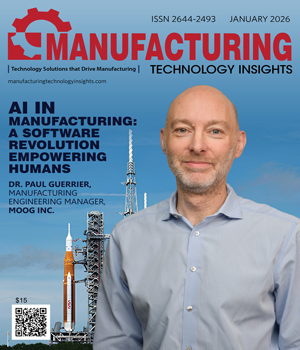
Paul Guerrier is an experienced engineering leader specializing in advanced manufacturing and product development. Currently Manufacturing Engineering Manager at Moog Inc., he has been with the company for nearly 20 years, holding key roles in manufacturing. Prior to Moog, he worked as a senior engineer at Torotrak and BAE Systems. Paul holds a PhD in Mechanical Engineering and an MSc in Fluid Power Systems from the University of Bath. With his expertise, he has earned multiple endorsements from industry peers. Through this article, Guerrier emphasizes importance of AI’s impact on manufacturing and its role as a flexible software layer that enhances efficiency. He also provides insights on the potential of synergistic partnership with human ingenuity and strategic decision-making. AT A GLANCE: • While AI offers unprecedented efficiency, it will remain dependent on human leadership to navigate its limitations—especially its tendency toward reversion to the mean. • AI cannot define its own purpose or make strategic decisions—it depends on human expertise to guide its application. • The future of manufacturing lies in a synergistic partnership between humans and AI. While AI automates repetitive tasks, humans will focus on high-level innovation and strategic decisionmaking.
Since 2001, Southern Tool Specialist (STS) has been helping manufacturers push the boundaries of productivity, quality and safety through advanced assembly tools and integrated manufacturing systems. The goal is to support customers through implementation and long-term use rather than simply supplying a product. Over the years, STS has earned its reputation by staying true to a simple belief that the right solution will always outlast the sale. The company’s foundation in assembly solutions and its early experience in motor vehicle manufacturing taught the team lessons about process control, ergonomics, repeatability, and quality. Today, STS has expanded into all manufacturing segments from light electronics into transportation, energy, defense, recreation, and everything in between. “No matter the industry, our approach has always been to understand the process, engineer the right solution, and stand behind it, even if it takes years to develop. Patience builds partnerships stronger than any purchase order,” says Joshua W. Bruce, Vice President of Sales & Business Development. Precision Engineering Strengthening Customer Performance Aerospace has become one of STS’s active areas of growth in recent years. Working alongside its long-term partner Lübbering, the company has helped major manufacturers such as SpaceX, Blue Origin, Airbus, and Spirit adopt more advanced drilling technology. STS began by serving customers in Alabama, Mississippi, Louisiana, and the Florida Panhandle and has since expanded into the Mid Atlantic, Kentucky, Florida, and select West Coast regions. This reach allows the company to support national projects while working directly with corporate engineering teams to keep local execution aligned with global standards..


LM3 Technologiesis redefining what’s possible in manufacturing inspection by delivering advanced, integrated AI vision systems that bridge the gap between reliability, traceability and full plant-floor integration. From catching surface-level cosmetic defects to orchestrating robot-guided inspections and closing gaps in legacy systems, LM3 is leading a new wave of production-ready, scalable AI vision. Founded in 2009 by Michael Walt II, LM3 Technologies emerged from decades of expertise in automotive electrical and seat system testing. Drawing from his experience building full-seat validation platforms and working alongside the world’s largest automotive OEMs, Walt founded LM3 with the goal of building smarter inspection tools for a wider range of industries. “Our goal has always been to create a practical, scalable solution that smaller and mid-sized manufacturers could actually implement—without sacrificing performance,” says Michael Walt II, founder and president. That philosophy led to the creation of QC Hero, LM3’s powerful AI training pipeline launched in 2017. Built for manufacturers, QC Hero enables companies to train defect detection models from their own part images and deploy them in hours, not weeks. The platform is cloud-based, leveraging Google Cloud TPUs to reduce training cycles from 24 hours to under two. At just $700 per model, QC Hero offers a dramatic cost advantage over enterprise solutions that start at $50,000+ and often lock customers into complex licensing models. “We created QC Hero and designed PAQi because we saw firsthand how difficult it was for manufacturers to get AI into production. Either the tools were too expensive, too slow, or just didn’t integrate with the rest of the plant. We wanted to make AI inspection something that actually works for real operators and engineers on the floor,” says Walt. LM3’s AI models run directly on PAQi: a model- and camera-agnostic, edge-deployed controller that serves as the heart of the LM3 ecosystem. PAQi can run up to six cameras, includes local storage via SQL and features built-in integration with industrial protocols like PROFINET, Modbus and Ethernet/IP. This architecture allows LM3 systems to fully integrate into existing PLCs, MES systems and line controls without custom middleware—a major differentiator from many vision companies that provide only standalone results or lack traceability.
As products grow increasingly intricate and time-to-market becomes a critical determinant of competitive viability, SAP partner ILC is quietly emerging as a powerhouse in Product Lifecycle Management (PLM). At its core, ILC addresses a fundamental conundrum that global manufacturers face: managing massive configuration complexity without compromising speed, cost, or scalability. Its answer is the Product Variant Concentrator, an easy-to-use flagship solution for companies grappling with thousands of ever-evolving product configurations. This offering is built on a distinctive philosophy of being “fully SAP-embedded” without requiring code. It operates without disrupting clients’ existing SAP architecture and eliminates the need for middleware, third-party connectors, or workaround integrations. Such seamless native integration unlocks vast possibilities, streamlining data flow between engineering and production. It minimizes friction, delays, errors, and overhead, ultimately maximizing profits through better resource utilization and enhanced productivity. “Our solution combines a preconfigured reference process with open customization. You won’t find anything else like it on the market. Clients don’t have to choose between standardization and flexibility; they get both,” says Markus Heise, CEO of ILC North America. This balance between structure and adaptability has proven valuable for manufacturers under pressure to innovate rapidly. One lighting manufacturer, for instance, previously struggled to manage just 300 product variants due to the manual burden placed on its engineering team. After deploying ILC’s PLM suite, that same team handles over 12,000 variants with faster turnaround and reduced costs. More than just achieving control, the client gained strategic agility, being able to respond faster to market demands without expanding headcount or compromising quality.


Michelle Jones, Creative Marketing and EX Manager, East West Manufacturing

Gary Sieber, National Sales Manager, Welch Packaging

John Connell, Vice President of SLI Products Group, Crown Battery Manufacturing

Kim Jessum, VP Legal, Global Legal Business Partner, and Associate General Counsel, Chief IP Counsel U.S. & Secretary, Heraeus

Tiziana Carrubba Cacciola, CMO, OTC, Beverage & Personal Care, Genomma Lab
Modern manufacturing ROI prioritizes data integration and real-time intelligence, enhancing efficiency, reducing costs, and optimizing productivity through seamless convergence of operational and information technology.
MES and MOM systems are central to smart factories, enabling real-time transparency, autonomous AI-driven optimization, and sustainability, transforming manufacturing into more efficient, flexible, and environmentally responsible operations.
The Evolution of Manufacturing in the U.S.
Southern Tool Specialist (STS) exemplifies this shift, bridging vision and execution with unmatched precision. As a premier provider of advanced assembly and drilling solutions, STS drives operational excellence via its innovative Smart Factory systems, seasoned expert consulting, and a robust lineup of high-performance industrial tools. Established in 2001, the company caters to aerospace, automotive, and general manufacturing sectors, consistently raising the bar for precision engineering and intelligent production workflows that synchronize data, machinery, and human oversight.
The 2025 market narrative highlights the urgency of these advancements. Rapid digital adoption, fueled by AI-driven process controls and strategic reshoring, propelled growth as manufacturers fortified supply chains against global disruptions. Yet headwinds persisted, acute component shortages strained inventories, skilled labor shortages hampered scaling, and surging energy costs squeezed margins across operations.
Manufacturers rose to these tests with resilience. They embraced agile process redesigns, forged tighter supplier alliances for just-in-time reliability, and reinvigorated lean methodologies that harmonized cutting-edge tech with skilled craftsmanship. These adaptations revealed a pivotal truth; enduring competitiveness hinges on blending automation’s power with organizational agility and human insight.
This feature amplifies voices steering this trajectory. Tiziana Carrubba Cacciola, CMO, OTC, Beverage & Personal Care at Genomma Lab, and Billy Ingram, Director Lean Product and Process Development at Interface, provide candid perspectives on emerging priorities in process innovation, from AI-enhanced quality assurance to PLM-orchestrated lifecycle efficiency.
Looking ahead, 2026 beckons U.S. manufacturers toward holistic, intelligent ecosystems. The emphasis falls on harmonizing productivity gains with sustainability imperatives and workforce upskilling, ushering in an era of truly connected manufacturing intelligence.

Manufacturing Technology Insights Weekly Brief
Be first to read the latest tech news, Industry Leader's Insights, and CIO interviews of medium and large enterprises exclusively from Manufacturing Technology Insights
