

THANK YOU FOR SUBSCRIBING
A featured contribution from Leadership Perspectives: a curated forum reserved for leaders nominated by our subscribers and vetted by our Manufacturing Technology Insights Advisory Board.


Almost all organizations recognize the benefits of Operational Excellence (OPEX) or Lean 6-Sigma. Yet not many organizations have been successful in realizing the true benefits or sustaining the gains started earlier with the support of some external consultants or a few internal experts. Among the few most critical failure factors is lack of a model to manage the scale of breakthrough changes an OPEX journey entails. I am sharing some success stories based on my personal experience in deploying OPEX in three multi-national corporations, Caterpillar (CAT), Commercial Vehicle Group (CVG) and Superior Industries (SI) – all in manufacturing with CAT and CVG in a low volume and high mix environment and SI as an auto supplier within a high volume and low mix environment.
General Change Management Models
Abundant publications centered around change management. Classic books include John Kotter’s Leading Change (2012) with an 8-step model more from the academic / consultant perspective, David Pattruck’s Stacking the Deck (2015) with a 9-step model more from a business executive’s perspective, and Jeanenne LaMarsh’s Changing the Way We Change (1995) with a 3-stage model more from a consultant’s perspective.
Specific to the OPEX journey, four books stand out: Robert Slater’s Jack Welch and the GE Way (1999), David Mann’s Creating a Lean Culture (3rd Edition, 2015), Art Byrne’s Lean Turnaround (2012), and Eric Ries’s Lean Startup (2011). Although Ries’s Lean Startup focuses on starting a new business borrowing the concept of lean production, I consider starting an OPEX journey within an existing organization just like starting a new business or a new enterprise.
A Practical 4-Stage Model coupled with 4 Change Management Tools
After digesting the above and other models and based on my own experiments in leading large scale breakthrough changes including inputs from colleagues in the OPEX community, I offer a holistic and practical approach for a successful OPEX deployment. Like in any weight loss journey, every new movement is difficult to start; yet it is even much more difficult to sustain weight loss by keeping up the same diet habit, and by starting exercises to build more muscles. For this topic, TED Talk How to Start a Movement offers some tips.
Among the four change management tools abbreviated as ACER in the first column of Table 1, we view the first three tools more critical to a successful startup, speedup and scaleup – the first three of the four stages based on the 4S Model in the first 2 rows of the table.
After the first success with one pilot program, for example at one casting machine, we need to Speedup the deployment to other casting machines or to machining centers within one facility. Once we have a good success in the first replication within one facility, we naturally move to realize the benefit of Scaleup by replicating the same recipe to the other facilities – first to the same process(s) such as from improving casting OEE at facility 1 to improving casting OEE at facilities 2 and 3. Within each of the Scaleup facilities, we should then repeat the recipe of Startup and Speedup by moving from one process to the other processes.
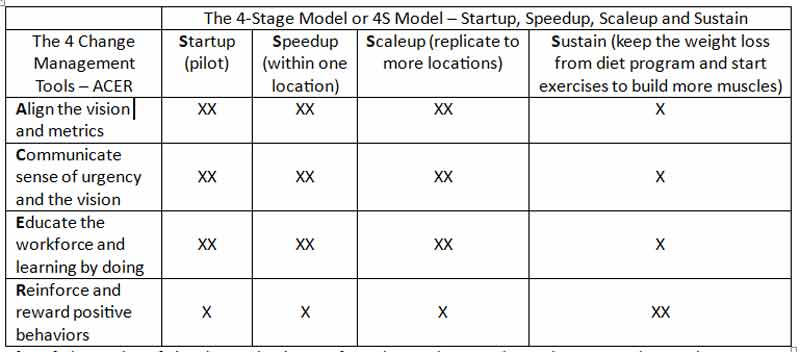 Table 1: Four Change Management Tools for Four Stages of OPEX Deployment
[Note] The number of X’s indicates the degree of correlation: The more the Xs, the stronger the correlation.
Five Change Management Programs to Sustain the Gains and Movement
While the first three tools in the first column are more critical in supporting the first three stages Startup, Speedup and Scaleup, the recipe for the Sustain stage could be the same for each success. We found the five key Change Management Programs in Table 2 extremely helpful in ensuring the fourth stage to be successful whether it is in a facility-wide, a division-wide or a corporate-wide OPEX deployment.
In conclusion, a successful OPEX deployment environment varies from company to company, even from region to region or facility to facility. While the commitment from the CEO and the CFO is considered the first and foremost success factor, the above four stages based on 4S coupled with the four change management tools (ACER) have worked well for us in the past decade or so among three very different companies across different industries. A word of caution: never underestimate the degree of resistance in leading any large-scale breakthrough changes such as in an OPEX deployment journey. That is why I have chosen this topic in my recent speeches and writings as it is a major gap in the current literature. Pick a model most suitable to your situation. My colleagues and I are more than happy to receive your constructive feedback and learn from your experience. Good luck in your OPEX journey.
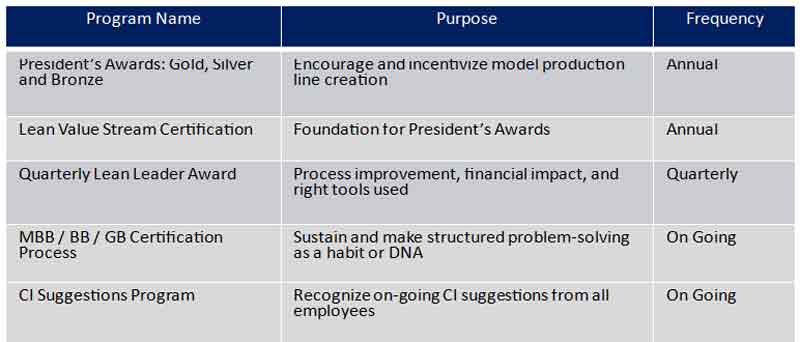 Table 2: Five Change Management Programs to Ensure Sustainability of OPEX Success

Manufacturing Technology Insights Weekly Brief
Be first to read the latest tech news, Industry Leader's Insights, and CIO interviews of medium and large enterprises exclusively from Manufacturing Technology Insights
