Evertiq Expo

Evertiq Expo

Manufacturing Technology Insights | Friday, October 17, 2025
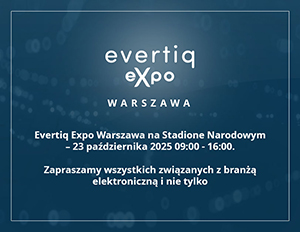
Evertiq Expo is Coming – On October 23, the Heart of the Electronics Industry Will Beat Again in Warsaw

It will be the most electrifying day of the year for manufacturers, distributors, designers, and enthusiasts of the electronics of the future! On October 23, the 10th edition of the international electronics industry trade show Evertiq Expo will take place at the National Stadium in Warsaw. Participants will have the opportunity to explore the latest solutions and trends, attend conferences with expert speakers, and network over coffee and snacks provided by the organizer.

The conference will feature inspiring topics related to the future of the EMS industry, which is currently experiencing turbulence. Experts will also explain why AI is on the edge, exploring the redefinition of artificial intelligence, and analyze the prospects for the development of the Polish industry. The Evertiq Expo in Warsaw will run from 9:00 AM to 4:00 PM. Participation is free. To join the event, simply register at: https://evertiq.pl/expo/waw2025_visit#Rejestracja

"In Warsaw beats the heart of the domestic industry, which is why this is where we will celebrate the most important event of the electronics industry in Poland. The anniversary edition of the expo will become a platform for exchanging experiences, sharing knowledge, and building valuable business relationships that often result in long-term partnerships,"emphasizes Daniel Myrtenblad, Project Manager of Evertiq Expo.

The organizer, active on the market since 1999, has built an international platform consisting of electronics industry news portals: Evertiq.com, Evertiq.se, Evertiq.de, Evertiq.pl, Evertiq.mx, Evertiq.es, and Evertiq.fr, as well as international trade shows held regularly in eight locations. Initially, all events shared the common name TEC (The Evertiq Conference), but in 2018, the company decided to rebrand and create Evertiq Expo – a strong global brand recognized in the electronics sector, distinguished by its reputation.

"By organizing Evertiq Expo in Warsaw, we continue the journey we started in 1999. Since then, we have built six industry portals, created an international cycle of trade shows, and now reach nearly 2 million people annually. We are delighted to bring together the global electronics community at Evertiq Expo in Warsaw, Kraków, Berlin, Tampere, Zurich, Malmö, Gothenburg, and the French Riviera. Over the past 25 years, we have built a community that believes in the power of electronics and fosters collaborations and business relationships that can make the world a better place,"concludes Daniel Myrtenblad.

The Warsaw expo will open with a discussion led by Ewelina Bednarz, Global Content Manager at Evertiq. Participants will look for bridges between regional events, the economy, politics, individual industry sectors, and the future of the electronics industry. By skillfully connecting the dots, will they be able to anticipate potential risks and future development directions? Insights on the future of the EMS industry will also be shared by seasoned analysts Mareika Haass from in4ma and Christoph Solka from the Global Electronics Association, who will present forecasts for 2026. Other speakers will cover topics such as electronic component recycling and breakthrough semiconductor solutions.

A distinguishing feature of Evertiq Expo is not only its professional and business value but also the focus on guest comfort. Attendees will have the opportunity to network and exchange ideas over free snacks and coffee. Successful business conversations can be commemorated with a keepsake photo taken by a professional photographer, who – as every year – will capture participants for free.

The organizers invite everyone to join Evertiq Expo.

More in News

Manufacturers operating at the forefront of semiconductor and advanced automation face a persistent tension between throughput and precision. Interconnect geometries continue to shrink below the micrometer scale, substrates increase in size and mass, and production lines are expected to sustain nanometer- level positioning stability over extended scanning cycles. Any degradation in motion performance directly affects yield, overlay accuracy and tool availability. For executives responsible for motion technology investments, the discussion is no longer about isolated components. It centers on who can assume responsibility for performance at the point where the process occurs. In this environment, a credible motion partner must control every layer that influences dynamic behavior. Motors, bearings, feedback systems, vibration isolation, structural frames and control electronics interact continuously. A stage optimized in isolation may underperform once integrated into a machine with external vibration sources, thermal drift or suboptimal feedback placement. Sustainable throughput and accuracy depend on an architecture that aligns mechanics, metrology and control bandwidth from the outset. Precision at the tool center point has become a defining benchmark. Mechanical stiffness alone cannot guarantee sub-100 nanometer positioning during long scan sequences. Direct metrology, positioned as close as possible to the process location, offers a more reliable path to dynamic accuracy. When multi-degree-of-freedom encoders measure motion in multiple axes simultaneously, they compensate for parasitic errors that accumulate in conventional stack- ups. This approach also preserves performance as payloads increase, such as the transition from 300 mm wafers to large panel formats. Control technology now plays an equally decisive role. Direct drive architectures eliminate transmission elements, but they demand higher control bandwidth, lower latency and superior signal integrity. Executives should expect controllers capable of fast encoder processing, deterministic communication and advanced filtering to suppress noise without sacrificing responsiveness. Functional safety certification at the highest levels is also essential in high- value fabrication environments where downtime carries significant financial impact. Throughput cannot be improved at the expense of jitter. Advanced packaging applications illustrate this balance clearly. One-micron interconnect dimensions imply positioning stability an order of magnitude tighter. Achieving that level historically required limiting power output, constraining acceleration or reducing productivity. The next generation of systems must deliver nanometer- level jitter while sustaining the force and speed required for heavy substrates and rapid cycling. Thermal stability and vibration management complete the picture. Larger chucks, warped substrates and integrated unwarping mechanisms increase system mass and thermal load. Active isolation, air or magnetic bearing technologies and integrated structural design are no longer optional enhancements. They are foundational to maintaining accuracy over hours of continuous operation. Within this context, ETEL represents a compelling benchmark. It has evolved from a motor specialist into a provider of fully integrated motion systems under its Full Forward Integration approach, assuming responsibility from frame and vibration isolation through direct drive stages and proprietary control. Its latest AccurET+ platform, officially launched in 2025, increases control bandwidth, reduces latency and supports Endat3 protocol compatibility, while TransnET provides deterministic 50 μs communication. The HDR option enables nanometer- level jitter even on high-power amplifiers. For lithography and advanced packaging, its forthcoming METIS HP full air bearing platform targets 100 nm class accuracy with sustained dynamic stability. Backed by Electronics Technical Competence Centers across key semiconductor regions, ETEL offers both technological depth and local support, making it a prudent choice for executives prioritizing precision, throughput and accountability in motion performance. ...Read more
In recent years, power electronics have experienced significant growth, with nearly every application today relying on power electronic equipment in some form. Understanding the benefits that have driven their widespread adoption is essential. Below are some of the key advantages and disadvantages of power electronic converters: The Advantages of Power Electronics Mass Production Technological developments in semiconductor manufacturing have led to the widespread and economical availability of power electronic devices. Because these devices are available at different voltage and current levels, several options are available. Highly Reliable When used under rated settings, these devices' robust, long-lasting performance and lack of mechanical moving components lead to fewer failures. Highly Efficient These devices function as switches in most applications, and we know that switches have very low power loss and switching losses in both ON and OFF modes. Negligible Maintenance Almost no maintenance is needed for the power electronic systems because they do not have any mechanical moving parts. Fast The dynamic response of power electronic systems is significantly faster than that of mechanical or electro-mechanical equipment. Size Compared to mechanical systems with comparable power ratings, these power electronic systems are much smaller, meaning they weigh less, take up less floor space, are easier to handle, require less installation, cost less to pack and ship, and have many other benefits. The Disadvantages of Power Electronics Harmonics Power electronic systems have only one significant drawback: they introduce significant harmonics to the power supply and associated load sides. The output voltage and current of the converters and the input current produce harmonics since they modify the sinusoidal waveform to meet the requirements. Both sides are now having a lot of problems because of these harmonics. If we have motors, harmonics on the load side lead to concerns like excessive heating, increased acoustic noise, torsional vibration of the motor shaft, malfunctions with DC motor commutation, etc. Therefore, modern VFD motors are specifically made to withstand the impacts of harmonics better. In addition, we offer filter circuits that limit the load's harmonics. Harmonics also cause a great deal of difficulties on the supply side. There is a significant impact on the functionality of other devices connected to the same source. Additionally, supply line harmonics cause radio interference with audio and video equipment and communication lines. In addition to this, the input side transformer overheats and loses efficiency. Special converter transformers are employed when the output of electronic devices, like industrial motor drives, has a significant amount of power. Low Power Factor Reactive power adjustment equipment must be installed because some power electronic converters have low input power factors. Low Overload Capacity Power electronic devices must stay within their rated current and voltage ranges. Excessive current can cause device failure and overheating. Protection measures like snubber circuits are crucial to avoid problems like incorrect triggering. ...Read more
Cloud-based manufacturing connected worker platforms are redefining modern factories by connecting frontline workers, equipment, and enterprise systems in real time. Today, connected worker platforms consolidate digital instructions, equipment monitoring, collaboration tools, and safety alerts, empowering employees to perform efficiently while ensuring compliance and operational continuity. As industry adoption accelerates, these platforms have become essential for manufacturers seeking productivity gains, operational resilience, and strategic workforce alignment. What Drives Connected Worker Platform Adoption in Manufacturing? Several market forces are driving the adoption of connected worker solutions. Manufacturers face increasing pressure to improve throughput, minimize downtime, and optimize workforce allocation amid labor shortages and rising production complexity. The proliferation of IoT-enabled machinery, digital twins, and smart factory initiatives has created a need for seamless connectivity between workers and equipment. Regulatory compliance and safety mandates further underscore the importance of real-time monitoring and reporting. Connected worker platforms address these challenges by reducing operational inefficiencies, enabling rapid issue resolution, and providing managers with actionable insights. Enterprises adopting these solutions can enhance performance, reduce operational costs, and build scalable processes that meet evolving industry demands. How Can AI and IoT Enhance Shop-Floor Performance? Connected worker platforms leverage advanced technologies to deliver measurable operational improvements across manufacturing environments. AI analyses historical production data to identify inefficiencies and recommend workflow optimisations that enhance throughput. Digital workflows and AR-guided instructions help reduce human error, accelerate onboarding and support workforce development. In this context, Arnouse Digital Devices Corp supports digital manufacturing environments by aligning with technologies that enhance operational efficiency and workforce performance. Cloud-native architectures enable scalability across multiple locations, while integration with ERP, MES and quality systems ensures alignment between shop-floor activities and enterprise-level objectives. Automation further streamlines workflows, from task assignment to approval and reporting, significantly reducing administrative overhead. Mobile-first functionality enables supervisors and frontline employees to access instructions, approve tasks, and track progress from anywhere, improving responsiveness and alignment between operations and strategic goals. Collectively, these innovations enhance productivity, operational visibility, and workforce safety, delivering measurable value for senior leadership. Allied General Industries LLC delivers manufacturing solutions that support operational efficiency and enhance performance across connected industrial environments. Connected worker platforms are applied across multiple manufacturing sectors. Automotive and electronics industries use AR-enabled guidance to improve assembly accuracy and reduce defects. Heavy industry and energy sectors employ IoT-enabled wearables for predictive maintenance and worker safety monitoring. Food, beverage, and pharmaceutical manufacturers leverage platforms to ensure compliance, quality, and traceability. Across all sectors, these platforms empower employees, reduce downtime, improve operational efficiency, and support continuous improvement initiatives. ...Read more
Web-based Human Machine Interface (HMI) tools in Europe are advancing rapidly as industries adopt more connected, flexible, and intelligent systems. Traditional HMI platforms that relied on fixed hardware are being replaced by browser-based solutions that provide real-time access, remote monitoring, and seamless interaction across devices. The transition is helping organisations improve operational visibility while reducing dependency on location-specific control systems. As industrial environments become more complex, Web HMI tools are evolving into central platforms that connect machines, data, and users. European industries are focusing on solutions that visualise data and enable faster decision-making and improved system control. How Can Open Technologies Facilitate Cross-Platform Access and Simplify Development? Web HMI tools are built using widely supported frameworks that allow them to run on multiple devices and operating systems without compatibility issues. The flexibility ensures that users can access and control systems from anywhere using standard web browsers. Operators can monitor and manage industrial processes through desktops, tablets, or mobile devices, enabling real-time control even when they are not physically present at the facility. Modern Web HMI tools offer user-friendly design environments that allow engineers to create and customise interfaces with minimal coding. It reduces development time and makes it easier to adapt systems to changing operational needs. Integration with edge systems is also improving performance. By processing data closer to the source, Web HMI tools can deliver faster responses and reduce delays in critical operations. How Can Scalability and Integration with Smart Systems Be Achieved? Security has become a top priority as connectivity increases. Advanced Web HMI tools are incorporating secure access controls, encrypted communication, and system monitoring features to protect sensitive data and ensure safe operations. The focus on security helps organisations manage risks while benefiting from remote access capabilities. Integration with broader digital ecosystems is enhancing functionality. Web HMI tools are increasingly connected with cloud platforms, IoT devices, and analytics systems, enabling more comprehensive monitoring and smarter decision-making. The interconnected approach supports predictive maintenance and improved system performance. User experience is improving as well. Modern interfaces are designed to be intuitive and visually clear, helping operators interact with systems more efficiently. ...Read more