


THANK YOU FOR SUBSCRIBING
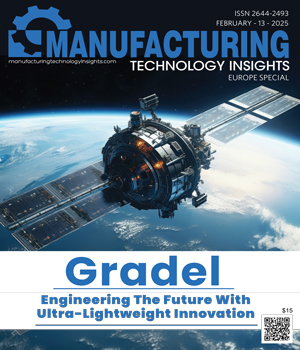
Lightweight materials are emerging as a critical driver of innovation across industries like space exploration, aeronautics and mobility in large sense. Pursuing lighter, stronger, and more efficient components is reshaping how organisations improve performance, reduce operational costs, and minimise energy consumption. Gradel, a Luxembourg-based engineering company that designs special purpose equipment for Space Industry, is leading this push toward smarter and more efficient lightweight components. For over 15 years, the company has provided solutions for handling, testing, and transporting satellites. However, recognising the rising demand for ultra-lightweight materials and their transformative potential across industries, Gradel charted a bold course of diversification five years ago. This strategic pivot gave rise to GRAM (Gradel Robotic Additive Manufacturing), a groundbreaking process poised to redefine composite manufacturing. This process sets new benchmarks in lightweight materials’ strength, sustainability, and precision across industries. “We saw an opportunity to add greater value to components and realised that lightweight solutions were no longer just a priority for space—they are essential across industries,” explains Claude Maack, CEO. GRAM: A Technological Leap in Lightweight Components Gradel’s GRAM technology is revolutionising composite manufacturing with its innovative, endless filament winding process. By mimicking bionic structures, GRAM aligns fibres along the natural flow of forces, adhering to the principle of “form follows force.” The GRAM process integrates inserts directly into the winding path, unlike traditional methods involving drilling holes and cutting fibres, compromising structural integrity. The result is a breakthrough in performance and weight reduction. Components manufactured using GRAM can handle five times the load of state-of-the-art solutions while achieving up to 70% weight savings compared to metal counterparts. Besides its versatility, GRAM supports many materials, including carbon, basalt, glass, and even renewable fibres like hemp or flax. These fibres can be paired with epoxy resins or customisable resin systems, including bio-based and recyclable options, allowing Gradel to tailor each solution to the specific needs of its applications. Its unique flexibility ensures optimal performance and sustainability through circularity by design, making GRAM a game-changer for industries striving to innovate responsibly. In industries like aviation, lightweight delivers not just operational savings but also significant environmental benefits. For example, reducing one kilogram of weight on an Airbus A320 can save 100 kilograms of fuel annually, translating to 350 kilograms less CO2 emissions. As airlines prepare for carbon taxes set to take effect by 2026, the ability to cut emissions and operating costs through innovative lightweight solutions becomes increasingly critical. “Using ultra-lightweight components isn’t just a technical benefit—it’s a business imperative,” Maack emphasises. “The operational savings, combined with environmental impact reductions, make GRAM a transformative process.”
Success in data-driven industries such as manufacturing and logistics is all about making smart, informed decisions in real time. Whether it’s a factory manager optimizing workflow or a logistics team streamlining operations, having access to precise data at the right moment can be a game-changer. This is where KINEXON excels— delivering cutting-edge tracking and analytics technology that helps businesses operate at their best. KINEXON isn’t just another tech company; it is transforming tracking and analytics by providing businesses with end-to-end visibility of their operations. By leveraging ultra-wideband, Bluetooth Low Energy and radio frequency identification, it provides location tracking and real-time visibility of production orders, inventory and assets. This ensures that industries such as manufacturing, logistics and warehousing optimize operational efficiency and streamline workflows. With these insights, businesses can enhance traceability, reduce operational bottlenecks, and improve efficiency and workplace safety. “Our vision is of a world in perfect flow. Wherever assets, people, or operations are in motion, we can improve and automate the underlying processes,” says Dr. Oliver Trinchera, co-founder and co-CEO. A powerful software platform, KINEXON OS, connects people, machines and goods in a seamless digital network. The system allows businesses to track materials instantaneously, automate workflows and eliminate inefficiencies. In addition, its SafeTag system enhances workplace safety, helping employees maintain safe distances and avoid risks in hazardous environments. By using SafeTag, companies can generate compliance reports and monitor workforce efficiency in large-scale industrial operations, creating safer and more productive workplaces.
Smart manufacturing demands intelligence at every level—and that starts with sensors and automation that go beyond traditional control systems. Hans Turck GmbH & Co., a specialist in smart sensor technology and decentralised automation, integrates control and logic capabilities directly into machines. Embedding intelligence directly into machines enables faster decision-making, greater flexibility and streamlined operations, paving the way for the next era of industrial automation. “We provide robust sensors and I/O solutions with IP67 rating and user-friendly software and services for reliably acquiring, processing and transferring relevant production data—from the sensor to the cloud,” says Aurelio Banda, president and CEO. With automation solutions designed to maximise machine availability and efficiency, Turck serves the pharmaceutical, chemical and automotive industries. Beyond these sectors, its expertise extends to specialised applications, including mobile machinery, intralogistics and packaging. Turck drives innovation by combining industry insights gained through close client collaborations with cutting-edge electronics development.
Material Handing
Janne Kuivalainen, CTO & Head of Technology, Danfoss Drives
Power Electronics
Peer Schumacher, Head of Electronics Manufacturing Solutions, Panasonic Connect
Connected Worker

Maurizio Pietropaolo, Industrial Supply Chain IS Technician, Thales Alenia Space
Thermal Management

Johannes Moritzhuber, Head of process and production development, Doppelmayr Seilbahnen
Lean Manufacturing

Trent Randles, Manufacturing Engineering Manager, BorgWarner
Prototype Engineering

Jason Bradley, Director Of Engineering, Mueller Water Products
Industrial Automation
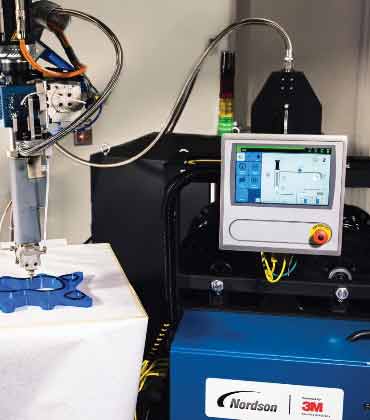
Larry Saidman, Chief Technologist - R&D, Nordson Corporation

Industrial Robotics
Nicola Sgambelluri, Engineering Manager, Pentair

Rubber and Tire Tech
Ralf Anderhofstadt, Head of Center of Competence Additive Manufacturing - Daimler Trucks & Buses, Daimler Buses | EvoBus GmbH
Hybrid robotic systems enhance flexibility, improve efficiency and ensure the production of complex, high-quality components, helping European businesses meet the growing demand for advanced manufacturing solutions. This process is critical for producing lightweight, high-strength components used across aerospace, automotive, energy, and construction industries.
The manufacturing sector, the backbone of many economies, has undergone a seismic shift with the rise of industrial robotics. Europe, in particular, has emerged as a global leader
The Impact of Robotic Filament Winding on High-Performance Composite Industries
In 2025, robotic filament winding will be characterized using multi-axis robotic arms equipped with advanced sensors and vision systems. These robots surpass traditional methods by precisely positioning fibres at specific angles and tension, ensuring the composite structure meets rigorous strength and durability requirements.
A significant advantage of robotic filament winding is its ability to customize winding patterns and fibre orientations, creating complex, non-linear shapes that traditional methods cannot achieve. For instance, in industries like aerospace, where weight reduction and structural integrity are paramount, robotic systems can optimize fibre placement to produce lightweight and exceptionally strong parts.
Similarly, in industries like wind energy, where large composite structures such as turbine blades are manufactured, the ability to produce lightweight and high-strength components can significantly reduce energy consumption. Optimizing material usage and reducing waste also helps reduce the environmental impact of composite manufacturing.
As demand for renewable energy sources continues to rise, this technology will play a pivotal role in supporting the development of more sustainable infrastructure. Several companies are now leveraging the technology to develop sustainable composites using recyclable, repairable, and reprocessable epoxy resins.
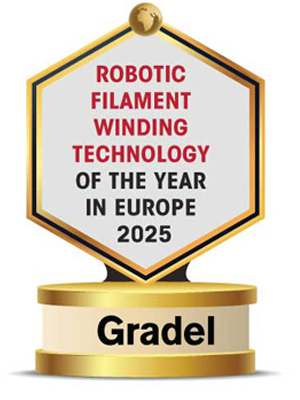
The edition, Robotic Filament Winding Technology of the Year in Europe 2025, features the expert perspectives of Nicola Sgambelluri, Engineering Manager at Pentair and Ralf Anderhofstadt, Head of Center of Competence Additive Manufacturing - Daimler Trucks & Buses, Daimler Buses | EvoBus GmbH. These esteemed individuals share their invaluable insights regarding the developments and challenges within the sector and possible solutions. We hope the insights from industry leaders featured in this edition will assist you in making informed decisions for your businesses.

Manufacturing Technology Insights Weekly Brief
Be first to read the latest tech news, Industry Leader's Insights, and CIO interviews of medium and large enterprises exclusively from Manufacturing Technology Insights
