

THANK YOU FOR SUBSCRIBING
A featured contribution from Leadership Perspectives: a curated forum reserved for leaders nominated by our subscribers and vetted by our Manufacturing Technology Insights Advisory Board.


Dewi Fitriyati is a seasoned Business Development and Marketing Manager at PT. Katolec Indonesia brings over 15 years of expertise in marketing within the manufacturing industry. She excels in market analysis, crafting effective marketing strategies, forecasting revenue, and managing junior marketing teams to achieve organizational goals.
The Sustainable Development Goals (SDGs) established by the United Nations provide a global agenda for peace, human well-being, and the protection of our planet. There are 17 of them, each addressing key challenges facing the world today, such as poverty, inequality, climate change, and environmental degradation. Companies play a key role in achieving these goals through their business actions, sustainability strategies, and collaboration with various stakeholders. Companies can support the Sustainable Development Goals by integrating sustainable practices into their business operations, sustainable production, ethical management, social responsibility, partnerships, and employee engagement in volunteering.
For example, in the Katolec Group, we have been contributing to the realization of a prosperous society by addressing social issues through our logistics and electronics (EMS) business. However, social issues on a global scale have become more serious in recent years, and efforts to address them are becoming increasingly important. Accordingly, we view the Sustainable Development Goals (SDGs) adopted by the United Nations in 2015 as an important objective to lead the world and subscribe to this vision. We further declare that we will proactively work toward the realization of a sustainable society through our business by pursuing economic value for our company while at the same time-solving social issues.
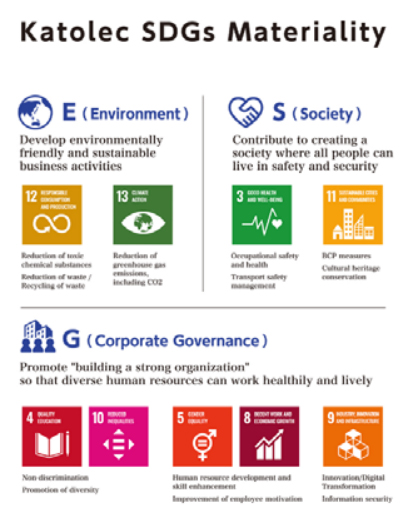 To incorporate the SDGs into our management measures, we assessed and analyzed the connection between the SDGs and the efforts of each division and identified "important issues (materiality) that we are working on to solve the social issues." As a result of the review, we have identified the following nine goals as our materiality and will promote our activities going forward.
E (Environment)
We develop environmentally friendly and sustainable business activities as a reflection of SDG goals no. 12 (responsible consumption and production) and 13 (climate action). We reduce toxic chemical substances and greenhouse gas emissions, including CO2.
S (Society)
We contribute to creating a society where all people can live in security and safety. This is to execute SDG goals no 3 (Good Health and Well-Being) & 11 (Sustainable Cities and Communities). We have arranged occupational safety and health, transport safety management, BCP measures, and cultural heritage conservation.
G (Corporate Governance)
We promote “building a strong organization” so that diverse human resources can work healthily and effectively. These are to implement SDG goals no 4 (Quality education) and 10 (reduce inequalities) by making nondiscrimination promotion of diversity. From a gender equality point of view (SDG goal no 5) and decent work & economic growth (SDG goal no 8), we implement human resources development and skill enhancement and improve employee motivation. Through SDG goal no 9 (industry, innovation, and infrastructure), we always maintain information security and innovation/digital transformation.
Companies have great potential to support the Sustainable Development Goals by integrating sustainable practices into their business operations. Actions in each of the 17 goals can contribute to creating a better world for us all. Katolec group shows how community engagement and collaboration can lead to real change by promoting sustainability and environmental protection. Engaging with the SDGs is not only a moral obligation but also an opportunity to build sustainable business success and a positive image in the eyes of employees, customers, and society at large.

Manufacturing Technology Insights Weekly Brief
Be first to read the latest tech news, Industry Leader's Insights, and CIO interviews of medium and large enterprises exclusively from Manufacturing Technology Insights
