


THANK YOU FOR SUBSCRIBING

![Donaldson [NYSE:DCI]: Filtration Designed Around What Comes Next](/company_logos/Untitled-6-i8nuf.jpg "Donaldson [NYSE:DCI]: Filtration Designed Around What Comes Next")
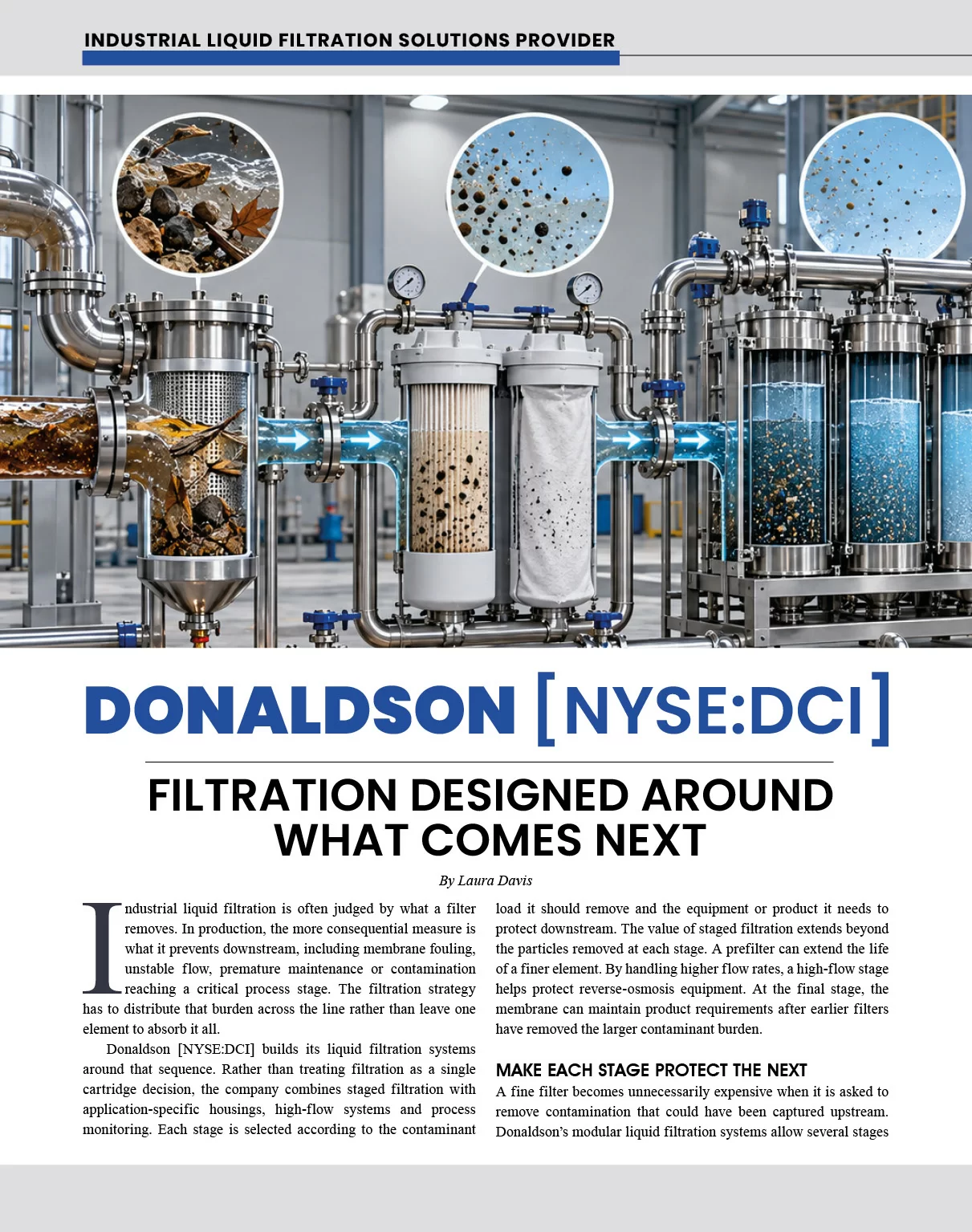
Donaldson [NYSE:DCI] builds its liquid filtration systems around that sequence. Rather than treating filtration as a single cartridge decision, the company combines staged filtration with application-specific housings, high-flow systems and process monitoring. Each stage is selected according to the contaminant load it should remove and the equipment or product it needs to protect downstream. The value of staged filtration extends beyond the particles removed at each stage. A prefilter can extend the life of a finer element. By handling higher flow rates, a high-flow stage helps protect reverse-osmosis equipment. At the final stage, the membrane can maintain product requirements after earlier filters have removed the larger contaminant burden.
Make Each Stage Protect the Next
A fine filter becomes unnecessarily expensive when it is asked to remove contamination that could have been captured upstream. Donaldson’s modular liquid filtration systems allow several stages to be configured around the needs of the process. Depending on the application, a system can combine coarse prefiltration with progressively finer elements before the liquid reaches its final treatment stage. Parallel configurations can also be used where redundancy or continuous operation is required. Each filter should remove the contamination best suited to its design while leaving the next stage with a more manageable load.
Donaldson’s LifeTec portfolio supports that progression with filtration grades suited to different points in the process. Coarser polypropylene elements can be positioned upstream, while finer membrane elements handle more demanding final filtration requirements. The result is a filtration train in which performance is distributed across the system instead of concentrated in the most expensive element.
This approach also changes maintenance economics. Extending the service life of a final filter can reduce replacement frequency while keeping differential pressure from rising prematurely.
Protect the Equipment That Carries Greater Value
Donaldson’s High Flow Skid brings this staged approach to industrial-scale applications.

Donaldson designs filtration around what the liquid encounters next, allowing each stage to remove the burden best suited to it before the process moves downstream.
Match the Hardware to the Liquid
Micron rating is only one part of filter selection. The liquid itself determines what the surrounding filtration hardware must tolerate.
Donaldson supplies stainless-steel housings for process water, industrial fluids, solvents and sanitary applications. Depending on the configuration, these systems can support cartridge or bag filtration and can be incorporated into controlled processing environments where cleaning requirements are important.
The application determines the right combination of housing and filter media. Flow conditions and process chemistry have to align with the filtration target before the system is installed. The result is a filter that matches the process rather than one selected only by micron rating.
Design Maintenance into the System
Every filter eventually requires attention. The more useful question is whether servicing it has to interrupt production.
Depending on the configuration, Donaldson’s liquid systems can incorporate Clean-In-Place capability and automated venting, along with product recovery, process-parameter monitoring and automated changeover between parallel filtration trains. For sterile water and other controlled applications, additional features can support sanitization and integrity testing. Parallel arrangements make it possible for one side of the system to remain available while another is being serviced, depending on the process design.
The filtration architecture accounts for maintenance from the beginning, and the benefit is not simply fewer filter changes. A plant can plan around the fact that an element will eventually load with contamination, rather than treating every service event as an unexpected interruption. Monitoring differential pressure provides an indication of when that loading is becoming significant, giving operators a clearer basis for intervention.
Filtration becomes easier to manage as part of production rather than as a component that only attracts attention when flow begins to suffer.
Get More Work from the Filtration Media
The system architecture depends ultimately on what the filter element can hold while maintaining useful flow.
Donaldson developed LifeTec liquid elements around contaminant capacity and pressure performance. Its pleated designs increase the available filtration area compared with conventional depth-style media, allowing more contamination to be retained before the element reaches its service limit.
In comparative testing, the LifeTec element used in the evaluation showed 47 percent greater dirt-holding capacity and 44 percent lower initial pressure drop than the conventional element it was measured against. Those figures are specific to the company’s test conditions, but they illustrate the relationship between media design and operating performance. Lower pressure drop reduces the hydraulic penalty introduced by filtration. Greater contaminant capacity can extend the useful interval before the element needs replacement.
In process-water installations, polypropylene prefilters protect finer final elements. The purpose is not to make every stage equally precise, but to place precision where it delivers the greatest value.
Donaldson approaches filtration as a process in which each element and housing has a specific responsibility. Upstream stages remove the burden they can handle economically, while finer filtration protects the product or equipment that follows. The result is a system designed to distribute contaminant load across the process rather than place it on a single element. The strongest filtration system is therefore not the one with the finest filter at every point. It is the one that makes each stage do the right amount of work before the liquid moves on.

Company
Donaldson [NYSE:DCI]
Management
Richard B. Lewis, President and CEO
Description
Donaldson provides industrial liquid filtration systems for process water, chemicals, coolants and sanitary applications, combining high-flow skids, application-specific housings, staged filtration and LifeTec media to protect downstream equipment, improve process control, reduce maintenance burden and support reliable manufacturing operations worldwide.

Manufacturing Technology Insights Weekly Brief
Be first to read the latest tech news, Industry Leader's Insights, and CIO interviews of medium and large enterprises exclusively from Manufacturing Technology Insights
