Ducker Conveyor Systems | Top Heavy-Duty Conveyor Systems Manufacturer

Ducker Conveyor Systems


Software-Driven Conveyor Infrastructure for Corrugated Manufacturing

Share this Article:

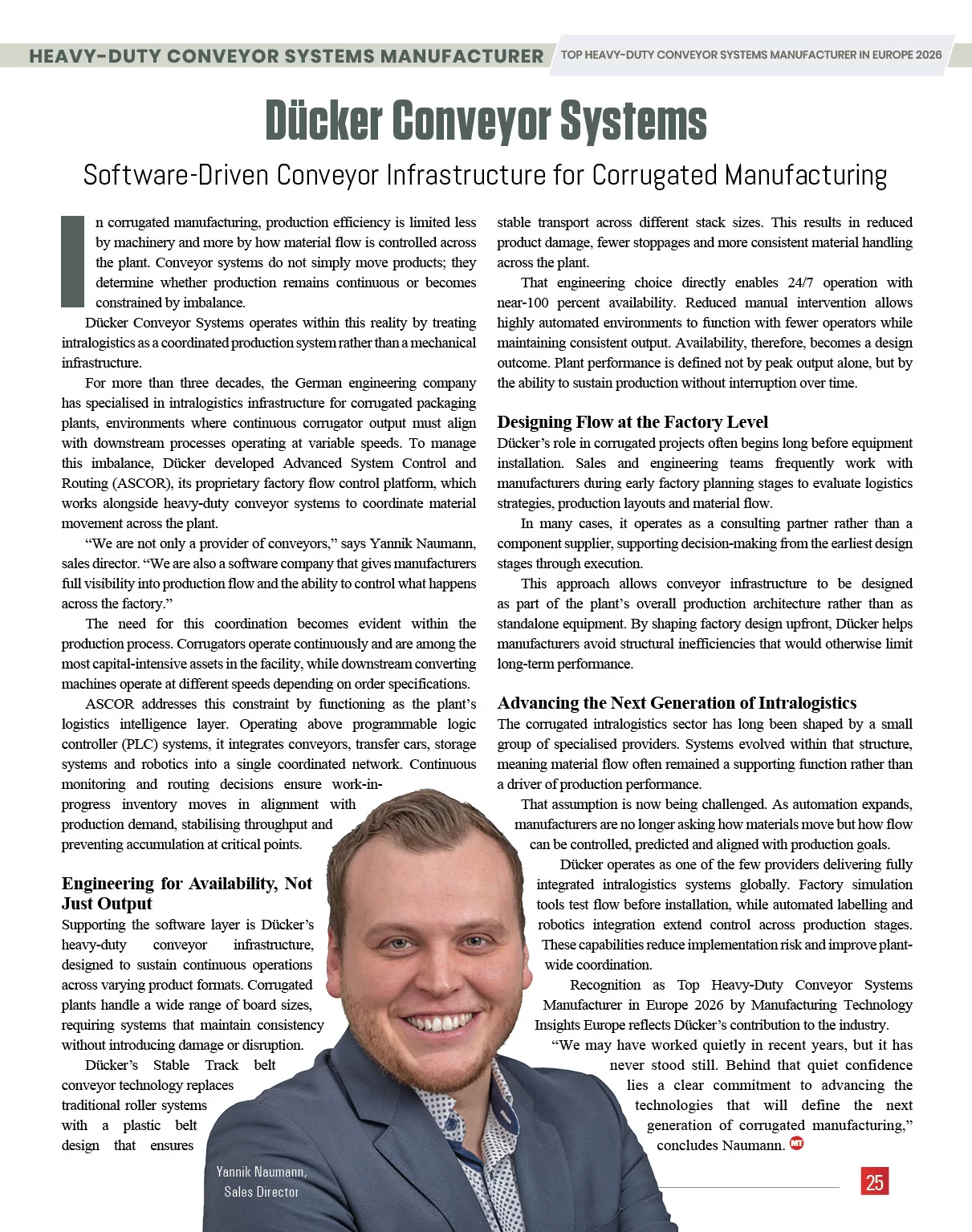
Yannik Naumann, Ducker Conveyor Systems | Manufacturing Tech Insights | Top Heavy-Duty Conveyor Systems Manufacturer in EuropeYannik Naumann, Sales Director
In corrugated manufacturing, production efficiency is limited less by machinery and more by how material flow is controlled across the plant. Conveyor systems do not simply move products; they determine whether production remains continuous or becomes constrained by imbalance.

Ducker Conveyor Systems operates within this reality by treating intralogistics as a coordinated production system rather than a mechanical infrastructure.

For more than three decades, the German engineering company has specialised in intralogistics infrastructure for corrugated packaging plants, environments where continuous corrugator output must align with downstream processes operating at variable speeds. To manage this imbalance, Ducker developed Advanced System Control and Routing (ASCOR), its proprietary factory flow control platform, which works alongside heavy-duty conveyor systems to coordinate material movement across the plant.

“We are not only a provider of conveyors,” says Yannik Naumann, sales director. “We are also a software company that gives manufacturers full visibility into production flow and the ability to control what happens across the factory.”

The need for this coordination becomes evident within the production process. Corrugators operate continuously and are among the most capital-intensive assets in the facility, while downstream converting machines operate at different speeds depending on order specifications.

ASCOR addresses this constraint by functioning as the plant’s logistics intelligence layer. Operating above programmable logic controller (PLC) systems, it integrates conveyors, transfer cars, storage systems and robotics into a single coordinated network. Continuous monitoring and routing decisions ensure work-in-progress inventory moves in alignment with production demand, stabilising throughput and preventing accumulation at critical points.

Engineering for Availability, Not Just Output

Supporting the software layer is Ducker’s heavy-duty conveyor infrastructure, designed to sustain continuous operations across varying product formats. Corrugated plants handle a wide range of board sizes, requiring systems that maintain consistency without introducing damage or disruption.

Ducker’s Stable Track belt conveyor technology replaces traditional roller systems with a plastic belt design that ensures stable transport across different stack sizes. This results in reduced product damage, fewer stoppages and more consistent material handling across the plant.

  • We are not only a provider of conveyors. We are also a software company that gives manufacturers full visibility into production flow and the ability to control what happens across the factory.

That engineering choice directly enables 24/7 operation with near-100 percent availability. Reduced manual intervention allows highly automated environments to function with fewer operators while maintaining consistent output. Availability, therefore, becomes a design outcome. Plant performance is defined not by peak output alone, but by the ability to sustain production without interruption over time.

Designing Flow at the Factory Level

Ducker’s role in corrugated projects often begins long before equipment installation. Sales and engineering teams frequently work with manufacturers during early factory planning stages to evaluate logistics strategies, production layouts and material flow.

In many cases, it operates as a consulting partner rather than a component supplier, supporting decision-making from the earliest design stages through execution.

This approach allows conveyor infrastructure to be designed as part of the plant’s overall production architecture rather than as standalone equipment. By shaping factory design upfront, Ducker helps manufacturers avoid structural inefficiencies that would otherwise limit long-term performance.

Advancing the Next Generation of Intralogistics

The corrugated intralogistics sector has long been shaped by a small group of specialised providers. Systems evolved within that structure, meaning material flow often remained a supporting function rather than a driver of production performance.

That assumption is now being challenged. As automation expands, manufacturers are no longer asking how materials move but how flow can be controlled, predicted and aligned with production goals.

Ducker operates as one of the few providers delivering fully integrated intralogistics systems globally. Factory simulation tools test flow before installation, while automated labelling and robotics integration extend control across production stages. These capabilities reduce implementation risk and improve plant-wide coordination.

Recognition as Top Heavy-Duty Conveyor Systems Manufacturer in Europe 2026 by Manufacturing Technology Insights Europe reflects Ducker’s contribution to the industry. “We may have worked quietly in recent years, but it has never stood still. Behind that quiet confidence lies a clear commitment to advancing the technologies that will define the next generation of corrugated manufacturing,” concludes Naumann.
Deep Dive

Heavy-Duty Conveyor Systems for Digitally Integrated Manufacturing

Manufacturing plants that process high volumes of materials face a growing coordination challenge inside the factory itself. Automation has expanded across converting lines, robotics has become standard in packaging operations and digital monitoring now influences nearly every step of production. In that environment, the systems responsible for moving materials across a facility have shifted from simple transport equipment to infrastructure that influences plant stability, throughput consistency and capital utilisation. Executives evaluating heavy-duty conveyor systems increasingly treat internal material flow as a central element of manufacturing performance rather than background machinery. Corrugated packaging plants illustrate this shift clearly. Production begins with the corrugator, a capital-intensive line that produces continuous corrugated board. Converting lines then transform that board into finished boxes at varying speeds and batch sizes. Mismatches between these stages create bottlenecks, excess work-in-progress or idle machines. Material handling infrastructure, therefore, becomes the mechanism that balances these competing rhythms. A conveyor system capable of synchronising board production, storage buffers and downstream conversion lines allows factories to maintain consistent output while minimising stoppages. Plant leaders examine how intelligently the conveying system coordinates movement across the entire production environment. Traditional conveyors often focus on mechanical transport alone, leaving scheduling logic and material visibility to separate systems. Modern installations demand something more comprehensive. Software layers that track production flow, coordinate routing and control equipment behaviour have become increasingly important. Visibility across the plant floor enables managers to understand where material resides, how quickly it moves and where congestion may arise before it disrupts output. Stability also remains a defining concern. Packaging plants operate continuously, often targeting near round-the-clock production from their most expensive equipment. Material handling interruptions can halt multiple lines simultaneously, turning a minor mechanical issue into a costly stoppage. Reliable conveyance depends not only on component quality but also on the system’s ability to accommodate varying product sizes, different production speeds and the unpredictable nature of daily factory activity. Plants producing items ranging from small retail packages to large shipping containers must rely on a single infrastructure that handles wide dimensional variation without damaging product or disrupting flow. Another factor influencing executive decisions is the level of integration across factory technologies. Robotics now plays an expanding role in palletising, loading and handling finished stacks. When conveyors, robots and plant control software operate as disconnected elements, each interface introduces complexity and risk during installation or expansion. Manufacturing leaders increasingly prefer integrated architectures in which transport systems, robotic functions and production logic share a coordinated control layer. This reduces commissioning challenges, simplifies system upgrades and supports the long-term evolution of the facility. “The company’s architecture integrates conveyor hardware, robotics interfaces and factory control under a unified system that supervises material movement from board production through finished stack handling.” Strategic support during factory design has also gained importance. Conveyor suppliers who understand only the transport component provide limited value in large-scale manufacturing projects. Facilities benefit more from partners that participate early in plant planning, helping shape layout decisions, material buffering strategies and system coordination before construction begins. Early engagement enables factories to avoid inefficiencies that would otherwise remain embedded in their production flow for decades. Within this landscape, Dücker Conveyor Systems represents a specialised provider focused on complex material handling for corrugated packaging facilities. It has operated in this field for more than three decades, delivering integrated conveying infrastructure designed to support continuous production environments. Its approach combines mechanical conveyance with a proprietary control platform that manages factory flow and monitors production movement across the plant floor. The system coordinates conveyors, routing logic and automation layers through centralised software control. The company’s architecture integrates conveyor hardware, robotics interfaces and factory control under a unified system that supervises material movement from board production through finished stack handling. Its stable-track conveying technology uses a plastic belt transport designed to reduce product damage while accommodating a large variation in box dimensions. Engineering, programming and manufacturing remain centralised in Germany, allowing it to deliver consistent system quality across installations worldwide. Facilities deploying its systems benefit from coordinated software control, integrated automation capability and consulting support that begins during the earliest stages of factory planning. ...Read more
Top Heavy-Duty Conveyor Systems Manufacturer in Europe 2026

Company
Ducker Conveyor Systems

Management
Yannik Naumann, Sales Director

Description
Ducker Conveyor Systems is a German engineering company specialising in heavy-duty intralogistics solutions for the corrugated packaging industry. By integrating conveyor infrastructure, automated storage, robotics and its ASCOR control platform, the company enables manufacturers to optimise production flow, improve plant efficiency and sustain reliable 24/7 operations.