



THANK YOU FOR SUBSCRIBING
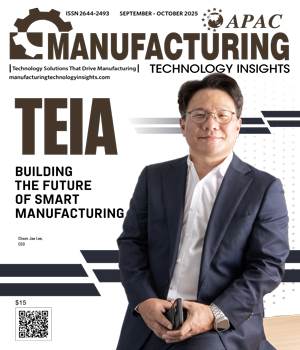
Smart manufacturing leaders need real-time, scalable solutions to navigate increasingly complex factory environments where every second counts and every decision impacts efficiency, quality, and cost. Massive data streams are constantly generated, but without the right tools, converting them into actionable insights is slow, costly, and error-prone. The future lies in solutions that converge AI and OT to streamline workflows, improve decision-making, and move factories closer to true autonomous manufacturing. TEIA rises to this challenge. Evolving from a traditional OT-focused quality platform provider, the company has become a future-ready, AI-driven enabler of autonomous manufacturing. By converging AI with operational technology (OT), it empowers manufacturers to monitor, analyze, and optimize production environments with speed, precision, and confidence. “We are the preferred choice of customers because of our ability to propose and integrate various technologies for immediate action. Our expertise in creating customized smart factory solutions makes us more attractive,” says Choon Jae Lee, CEO. Customer-Centric Solutions and Proven Capabilities TEIA’s clients consistently cite three drivers of loyalty: real-time problem-solving, integrated OT-IT expertise, and a culture of accountability to the shop floor. Rather than simply delivering solutions, TEIA acts as a technical partner, addressing core production challenges and generating measurable gains in productivity and quality. Founded in 2015 to bridge OT and IT, TEIA addressed a critical gap: few IT experts understood the complexity of automotive production, and traditional MES platforms failed to unify fragmented “islands of information.” Its mission was to enable real-time, data-driven production. Over time, TEIA expanded from quality-focused OT systems to IoT device development and integrated solutions for vision inspection, fluid dispensing, and holistic quality management—setting the stage for autonomous, intelligent manufacturing. At the core is TEIA’s S-OTPlat platform, which integrates IoT devices such as S-Tag, S-Anchor, and Smart Connector to capture real-time data from equipment, products, and environments. Its RTLS tracks assets with high accuracy via UWB and BLE, with hybrid indoor/outdoor modules in development for complex factory zones. S-OTPlat also features AI video inspection, 3D digital twins for visualization and simulation, and integration with PLC, MES, and ERP systems—including legacy equipment—enabling digital transformation without disruption.
Ensuring immaculate cleanliness within vacuum chambers is imperative to uphold the semiconductor industry’s stringent quality standards. Maintaining pristine chambers can prevent outgassing and product damage caused by particle and chemical contaminants. In addition, cleaners must attain the desired cleanliness despite the diverse manufacturing processes and coating materials manufacturers employ. To address these risks comprehensively, NICH Technologies, a vacuum application service provider, uses various precision cleaning methods. NICH Technologies delivers comprehensive engineering solutions that meet the cleaning needs of the semiconductor industry. The firm is capable of handling most of the decontamination by-products on stainless steel, ceramic, and quartz surfaces. “Our expertise lies in refurbishing and cleaning vacuum chamber components, which are crucial for evaporator, sputtering and etching,” says Jimmy Fung, director at NICH Technologies. The company selects the most appropriate precision surface cleaning treatment solutions based on its clients’ manufacturing processes or the coating material.

In the quest to curb global energy consumption and its consequential carbon emissions, mesoporous materials have been pivotal. These cutting-edge materials, engineered with finely tuned pore structures, represent a quantum leap in energy efficiency technology. At the forefront of this transformative technology is UniNano Advanced Materials, an enterprise specializing in industrializing mesoporous thermal insulation materials. Harnessing their unique properties, UniNano is setting new standards in sustainable practices with significant improvements in heat retention and energy savings. The company developed and industrialized diverse mesoporous materials with optimized pore structures, combining them with different fibers for enhanced thermal insulation. It achieves more than a 30 percent reduction in heat loss, surpassing traditional fiber-based materials like rock wool, aluminum silicate, and glass wool, which often suffer from inadequate thermal performance, energy efficiency and durability. UniNano prioritizes cost-effectiveness. Compared to advanced materials like nano-aerogels, its mesoporous materials provide similar energy-saving benefits at a lower cost. It furthered its impact by developing scalable preparation methods, cost-effective production techniques, and environmentally friendly processes to enable large-scale application of mesoporous materials in thermal insulation. Produced using a green, water-based synthesis approach, these flame-retardant materials with low combustion calorific value and high hydrophobicity ensure environmental friendliness and safety across diverse applications. Tested through rigorous, 40-year aging experiments, UniNano’s mesoporous composite insulation materials boast exceptional durability and use about 50 percent less space compared to conventional options.
Smart Factory

Stewart Johnstone, Vice President Asia, Adient [NYSE: ADNT]
Ceramic

Ari Wibowo, Lean and Advanced Manufacturing Senior Manager, New Balance
Smart Factory

Suci Ameliya Reza Zairizal, Associate Manager, Novugen Pharma
Smart Factory

Chris Allan, Director Accounts & Partnerships, NATS
Smart Factory

Tom Marzella, Commercial Director SEA & Oceania, Glanbia Nutritionals

Smart Factory
Carl Budd, Engineering Manager, Moose Toys

Smart Factory
Anton Setiawan, General Manager Information Technology, Panca Budi Tbk
The APAC manufacturing sector is integrating advanced materials and digital technologies to create smarter, more efficient factories, thereby enhancing competitiveness and sustainability amid challenges such as capital investment and workforce
The APAC manufacturing sector is shifting to smart factory ecosystems, leveraging hybrid cloud architecture for agility, scalability, and integration, which are essential for competitive, data-driven operations.
Drivers of the Next Industrial Revolution
The core drivers of this new era of manufacturing are smart factory technologies, which leverage AI, IoT robotics and real-time analytics to create self-optimizing production environments. Factories are becoming more agile by integrating digital twins and machine learning to respond instantly to changing demand or supply chain disruptions.
Complementing this digital backbone are advanced materials solutions. From lightweight composites and nanomaterials to energy-efficient alloys, leading providers are supplying manufacturers with the building blocks of tomorrow’s aerospace, automotive and electronics industries.
Equally critical are industrial vacuum processing systems, which support ultra-clean, controlled environments essential for semiconductors, photovoltaics and advanced coatings. These systems are reaching new levels of precision and scalability while minimizing waste and contamination, leading to breakthroughs in electronics, renewable energy and medical devices.
This edition of Manufacturing Technology Insights APAC brings the latest advancements and expert opinions on smart factories, materials science and industrial vacuum systems. It features a thought leadership article by Ari Wibowo, lean and advanced manufacturing senior manager at New Balance. He sheds light on how footwear manufacturers are implementing lean manufacturing and automation to improve their production processes and reduce costs.
Carl Budd, engineering manager at Moose Toys, discusses the need to adopt a multi-disciplinary approach to engineering design, which is a potential game-changer for organizations seeking to streamline processes and maximize efficiency gains.
We hope this edition will provide you insights into the leaders in smart factory technologies, advanced materials solutions and industrial vacuum processing systems that are changing the face of new-age manufacturing and making production floors Industry 4.0 ready.

Manufacturing Technology Insights Weekly Brief
Be first to read the latest tech news, Industry Leader's Insights, and CIO interviews of medium and large enterprises exclusively from Manufacturing Technology Insights
