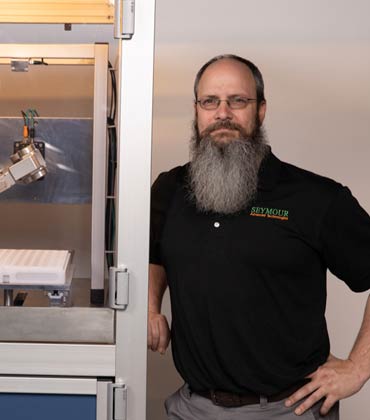
Rob Seymour is the Founder and CEO of SEYMOUR Advanced Technologies, an industry leader in custom automated machinery based in North Carolina. With deep roots in mechanical engineering and operations, Rob Seymour is passionate about micron-level precision, rapid prototyping, and building vertically integrated automation ecosystems that empower manufacturers and their workforces alike.
Transforming Manufacturing through Automation
It is an incredibly exciting time to be in manufacturing, though not without its challenges! Products are getting smaller, compliance rules are tighter, and supply chains are more unpredictable than ever. Off-the-shelf assembly lines just can't keep up anymore. That’s where custom industrial automation steps in to completely change the game. In fields like medical devices and micro-electronics, traditional handling is often too clumsy.
Custom automation allows us to achieve extreme, repeatable precision—down to the micron level. For example, in a recent project, our team integrated 6-axis robotics with magnetic levitation technology. The result was amazing: it gave us 12 degrees of freedom to manipulate delicate, microscopic components in a cleanroom without touching them or causing contamination. When you can engineer solutions like that, you turn an operational nightmare into a massive competitive edge.
Leadership Lessons Driving Innovation
Growing up in this industry—moving from turning wrenches on the floor to managing engineering and operations—taught me a vital lesson: true innovation thrives on collaboration, not isolation. I discovered early on that you can find a comfortable "consistency in chaos" if you build the right framework for your team.
At SEYMOUR Advanced Technologies, this realization led us to build a fully vertically integrated culture. We intentionally put our design, additive and subtractive manufacturing, and software engineering teams under one roof. When mechanical engineers and software developers are collaborating side-by-side and sharing ideas on the floor, magic happens. We empower our folks to challenge the status quo and experiment constantly. When you have the tools to iterate a prototype in hours rather than months, innovation just naturally becomes part of your day-to-day.
Balancing Efficiency and Flexibility
-
Automation shouldn't be about replacing human ingenuity; it's about elevating it.
This is the golden question right now! The modern factory has to marry the relentless efficiency of robots with the agility to pivot when the market demands it. We've found the best way to do this is through interconnected, adaptable frameworks. By utilizing solutions like FlexSEY Modular Automation Cells, facilities can quickly reconfigure a line for a new product without tearing out their entire infrastructure.
But honestly, the most important part of this balancing act is the people. Automation shouldn't be about replacing human ingenuity; it’s about elevating it. Machines are fantastic at gathering real-time data and performing high-strain tasks such as micro-soldering or high-speed sorting. Humans, however, are the ultimate strategic problem solvers. By automating the physically taxing work, we free our workforce to focus on analyzing data, optimizing Overall Equipment Effectiveness (OEE), and making complex decisions.
Technologies Shaping Automation's Future
There are three big technological leaps I’m watching very closely. First, the integration of 3D cloud and machine vision. Giving robots the ability to "see" and process point clouds and depth maps in real-time allows them to dynamically adapt to spatial variations on the fly.
Second, advanced additive manufacturing has graduated from just making neat prototypes. It’s now essential for printing custom end-effectors and complex tooling on demand, which drastically reduces deployment times. Finally, the evolution of smart factory analytics—driven by IoT—is finally pushing us from reactive maintenance (fixing things when they break) to genuinely predictive, self-optimizing operations.
Advice for Future Professionals
My biggest piece of advice is to stay fiercely curious and cultivate a multidisciplinary mindset. The old walls separating mechanical, electrical, and software engineering are disappearing fast. Absolutely master the fundamentals of your specific field, but get comfortable with system integration, dive into 3D vision, and understand how data analytics work. Learn to collaborate across the aisle, and never be afraid to ask "why?" when examining a legacy process. Most importantly, keep in mind that we aren't just building cool machines. We’re engineering reliable, scalable solutions that solve real human problems and push the industry forward.