


THANK YOU FOR SUBSCRIBING


 Oscar E. Blanco, Founder and CEO
At the same time, a small team of South American engineers was learning the same point, with welding torches in their hands.
Robotic welding was still primitive then; there were no vision systems to locate shifting joints, automated controls to correct assembly gaps, or simulation to preview the manufacturing environment. When heat distorted a part, there was no algorithm to explain it. There was only the fixture, the weld sequence and the elimination of every variable to determine the cause of the problem. Progress came through observation, testing and repeated adjustment. The plateau was the work.
“We learned not just how to weld, but why welding behaves as it does,” says Oscar E. Blanco, founder and CEO. “We understood the problem before technology offered shortcuts.”
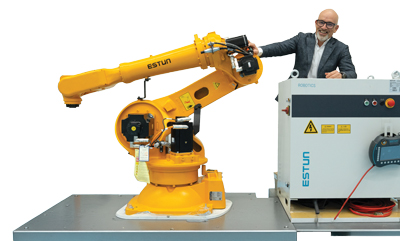 That deep operational knowledge became the foundation of Master Steel, the Mexico based industrial automation company that grew from those early lessons.
Rather than treating robotic welding as an isolated task, it begins with the manufacturing ecosystem that feeds it—cutting, bending, stamping, assembly, fixturing, handling and material flow. Every upstream operation introduces variation, which eventually shows up at the weld. Master Steel’s job is to map those relationships, locate the instability and engineer automation around the physics of the production floor.
This process first discipline shapes its MASTERWELD robotic welding systems and MASTERFAB manufacturing cells, which combine welding, positioning, material handling, adaptive tracking, inspection and automated fabrication into configurations built for the specific needs of each plant. Part of MASTER GROUP and operating in Mexico since 1998, Master Steel serves John Deere, Nissan, GE, Valeo, Mabe, Whirlpool and other manufacturers across automotive, heavy equipment and appliance sectors throughout LATAM.
“We have scaled operations, integrated advanced technology, expanded our team, but the core methodology persists intact,” adds Blanco. “Master the fundamentals first. Technology amplifies mastery; it doesn’t replace it.”
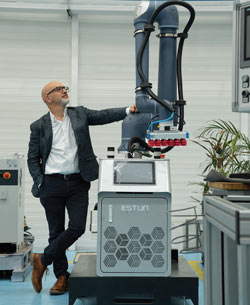
Where Fit Becomes Decisive
Automotive and heavy equipment fabrication operate at fundamentally different scales. An automotive supplier welds stamped steel at roughly two millimeters, with weld paths of 50 to 200 millimeters and components up to 100 kilograms. Heavy equipment fabricators run weld paths of 16 to 24 meters across structures weighing 8 to 20 tons.
LATAM’s supply chain has shifted around both. The traditional hierarchy—dominant players dictating terms to smaller ones—has given way to a balanced ecosystem where every tier carries strategic weight.
Master the fundamentals first. Technology amplifies mastery; it doesn’t replace it.
Advanced technology is mandatory at every level, but ‘mandatory’ does not mean indiscriminate. What gets installed matters as much as whether it gets installed at all.
Master Steel spends significant time inside customer facilities before proposing a solution. Engineers map how parts travel through production, studying bottlenecks, operator loading sequences, forklift movement, ergonomics, assembly conditions and the processes immediately upstream and downstream of welding. What they find often reshapes the project before a robot is specified.
One manufacturer approached Master Steel to automate its MIG welding line. The diagnostic revealed that inconsistent upstream bending was altering part geometry before the components reached the fixture. The fixture could not compensate and welding inherited the error in every cycle.
“In those situations, installing a faster robot would automate a problem, not solve it,” says Blanco.
The objective is not to install the most technology in a factory but to determine which technology yields the strongest manufacturing result.
Simulation That Removes Uncertainty
Once diagnostics are complete, a full 3D simulation of the customer’s facility is built. Welding cells, automated bending systems and material handling operations are modeled inside a virtual replica of the production floor. Weld cycle times are calculated from bead geometry. Forklift routes, loading sequences, handling distances and floor space are evaluated. Ergonomic modeling establishes operator positions, equipment interaction and safe material movement.
The output is a validated ROI projection grounded in cycle time analysis and implementation modeling. Clients considering capital investments exceeding half a million dollars can see where efficiency gains originate, how they affect throughput and what the investment will generate, before they place an order.
“Simulation converts possibility into validated performance,” says Blanco. “It gives clients confidence in implementation success.”
Engineering follows what the diagnostic revealed, not a standard platform. MASTER FAB welding cells address both automotive and heavy equipment conditions within a single framework, configured around each customer’s materials, geometry, volume and quality standards. Each cell is designed around the application.
Process selection follows the Welding Procedure Specification. Material, wall thickness, production volume and quality requirements determine whether the application calls for fusion TIG, cold wire TIG, hot wire TIG, hybrid MIG, spot welding or laser welding.
Fusion TIG without filler demands zero gap precision across cutting, bending and welding, with fixtures engineered to preserve assembly integrity and manage heat. TIG with filler supports gauge thicknesses starting at 2 millimeters and weld paths exceeding 500 millimeters, requiring higher production velocity while maintaining identical control over variables. Cold wire TIG suits thin wall applications in food processing, medical, nuclear, hydrogen, aerospace and pressure vessel sectors, where spatter free welds with minimal distortion are non negotiable.
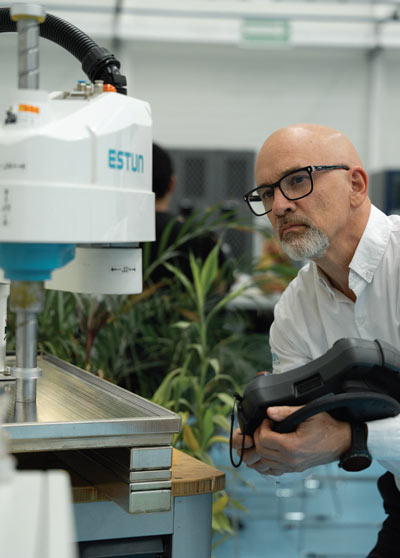 Seven modules connect in a continuous manufacturing sequence; ROBOCut laser cutting, ROBOHand positioning, RoboBENDING adaptive press brake forming, Quality Loop dimensional verification, Workflow Automation transfer, MASTERWELD robotic TIG welding and RoboGRINDING finishing. Dimensional accuracy is carried forward from the initial cut through the finished weld. No handoffs that introduce variation.
Robotic MIG welding reaches 28 to 32 inches per minute. A skilled manual operator typically works at eight. High volume operations prioritize fast cycles and continuous welding. High mix production requires flexibility, traceability and rapid changeovers. Automotive and appliance manufacturers emphasize throughput and repeatability. Aerospace, pressure vessel and medical applications demand greater precision and stricter validation.
“Our engineering approach is always application driven,” says Blanco. “Configured around technical requirements, production targets and long term automation strategy, the robotic manufacturing continuum can achieve ROI in less than 24 months.”
When Scale Tests the Weld
A manufacturer producing trailer platforms, dump bodies and 60 cubic meter gondola trailers needed to replace a manual welding process that could not sustain speed, repeatability or distortion control. Long welding cycles concentrate heat unevenly, causing large structural components to go out of tolerance. Rework was constantly needed. Production capacity had reached a ceiling.
Master Steel redesigned the process.
Multi robot MIG welding cells operated across T type gantry systems. Heavy duty positioners rotated loads exceeding 20 tons for optimal weld access. Laser seam tracking located each joint, compensated for dimensional tolerances and adjusted dynamically to gaps between assemblies. Coordinated weld sequencing balanced heat input across the structure.
Weld consistency improved. Thermal deformation and rework were reduced. Production capacity increased. Large scale fabrication became a controlled process in which robotics could detect variation, follow the joint and govern heat flow across structures far larger than anything on a conventional production line.
The Worker in the Equation
Installing a robotic system changes how a factory operates and what people inside it are asked to do. Master Steel addresses both simultaneously.
Before a system arrives, operators and technicians receive training in system operation, safety protocols and emerging technologies. Employees then operate the system and watch organizational objectives become achievable. When workers understand that technology supports their work without replacing it, confidence becomes ownership. Skills expand. Technological awareness grows across departments. Knowledge transfer continues until manufacturers develop independent capability.
“We want manufacturers to feel confident that Master Steel is their partner, not just in deploying systems, but in building lasting technological awareness and competency,” says Blanco.
The obligation extends further. Thousands of operators, welders and production personnel hold deep practical knowledge earned on the shop floor without access to formal technical education. Master Steel is developing training programs for this group.
“Industrial leaders must treat that investment as directly tied to productivity, quality and long term competitiveness. Skilled people who can work alongside automation and AI will determine what the next phase of manufacturing produces,” says Blanco.
Knowing When to Not Sell the Robot
Modern robotic systems can detect more, correct more and execute more than the machines Blanco started working with in 1991. What has not changed is the question that opens every project. It’s not about what technology to install, but whether a manufacturer is ready for it.
When clients contact Master Steel to automate a welding process, the answer is sometimes to wait. Bending accuracy may need improvement. Fixtures may need redesign. Assembly processes upstream of welding may be introducing variations that automation would accelerate. Master Steel has declined more business than most integrators ever see, guided by ‘Recommend what clients need, not what maximizes immediate revenue.’
That principle of choosing integrity over revenue governs prospective engagements. Master Steel conducts full welding trials for prospective clients; rigorous process tests designed to establish parameters, validate feasibility and prove the solution within the client’s specific operational conditions. Equipment time, technician hours and consumables are absorbed pre-contract and with no requirement for one going forward.
Work is measured by operational excellence, not invoice size. Five commitments hold constant as Master Steel expands. Comprehensive analysis before every proposal, transparent communication about readiness, human centered implementation, rigorous post deployment mentorship and genuine collaborative improvement.
“Technology tools evolve. Our commitment to excellence and integrity never does,” says Blanco.
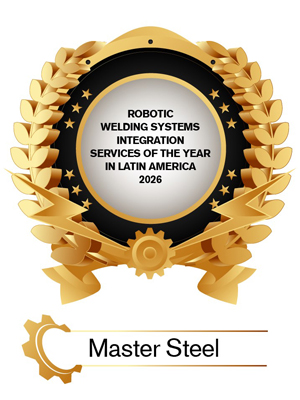
Manufacturing Technology Insights recognized Master Steel as the Robotic Welding Systems Integration Services of the Year in Latin America 2026. The recognition measures the technology. The technology reflects 35 years of staying on the path.
It is a path sustained by a passion for solving manufacturing challenges and a genuine commitment to shared success. “That passion is invisible until you experience it. But clients recognize it instantly. And they never forget it.”
Company
Master Steel
Management
Oscar E. Blanco, Founder and CEO
Description
Master Steel engineers application-specific robotic welding and automated fabrication systems for manufacturers across LATAM. Through factory diagnostics, 3D simulation, process validation and operator training, it aligns each technology investment with production realities, delivering controlled quality, higher throughput and measurable returns.

Manufacturing Technology Insights Weekly Brief
Be first to read the latest tech news, Industry Leader's Insights, and CIO interviews of medium and large enterprises exclusively from Manufacturing Technology Insights
