


THANK YOU FOR SUBSCRIBING


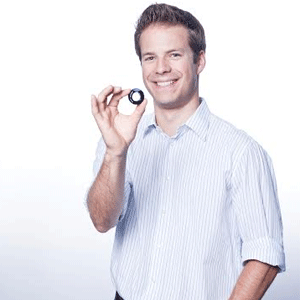 Mark Ventura, Founder, VP-Sales & Marketing
“All the MV systems require ‘the image’ to be in focus. However, it’s increasingly challenging to obtain that focus in dynamic environments,” says Mark Ventura, who today is responsible for Sales and Marketing at Optotune. While using fixed focus optics, designers have to mechanically move the product or the camera to find the right focus or use multiple camera systems at different focus positions. By integrating Optotune’s fast and reliable focus tunable lenses into their MV systems, the designers can change the focus electronically.
“The biggest benefit is provided when frequent focusing is required, for example if the features to be inspected on a product are at different working distances,” says Ventura. “With a response time in the millisecond range, the focus of our lenses can be adjusted numerous times per product, removing the need for multiple camera systems.” There are also benefits when occasional focusing is required, for example at initial installation or when switching between batches of different products. Using the electrical lens, an autofocus routine or even a remote user can adjust the focus. The company ultimately delivers flexibility and faster inspection time which can significantly increase the return on investment.

With a response time in the millisecond range, the focus of our lenses can be adjusted numerous times per product
Most of Optotune’s lenses are singlets that are modularly combined with off-the-shelf optics. For example, to change the focus from infinity to 50 mm, the tunable lenses must be mounted in front of a fixed focus lens and its optical power has to be changed from zero to 20 diopters. “The tunable lens can also be placed at the back of a fixed lens for macro-imaging, or in between objective and tube lens, which is suitable for high magnifications,” explains Ventura. “The faster response time combined with higher frame-rates allow for modern applications, including fast autofocus or image stacking, which can provide 3D data or ‘hyper-focus images’ if merged in software.” The manufacturers also have an alternative way to use the lens in combination with a distance sensor. After calibrating a few distance and corresponding focus points, the images can be in focus over a large working distance almost instantly.
Having gained the trust of large OEMs who frequently fund the development of highly customized solutions, Optotune is working on a long pipeline of new products. Additionally, Optotune’s application engineers solve customers’ problems that go beyond their lenses. In the coming days, the company will be seen bringing out integrated optical designs to offer the best possible performance for telecentric lenses and larger sensors. “Facilitating seamless connectivity and integration into cameras is also on the agenda,” concludes Ventura.

Company
Optotune
Management
Mark Ventura, Founder, VP-Sales & Marketing
Description
Designs and manufactures elastic polymer based focus-tunable lenses

Manufacturing Technology Insights Weekly Brief
Be first to read the latest tech news, Industry Leader's Insights, and CIO interviews of medium and large enterprises exclusively from Manufacturing Technology Insights
