

THANK YOU FOR SUBSCRIBING


What core shop-floor inefficiency does Quasi Robotics directly address with autonomous cart design?
The company targets a universal shop-floor pain point of excessive walking. In work-in-process flows, repetitive station-to-station transport can cost roughly three hours per shift, pulling workers away from value-added work and breaking focus.
Why does Quasi Robotics emphasize point-of-use delivery over pallet-based autonomous transport systems?
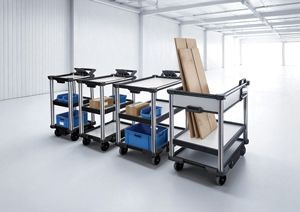 Because the waste is driven by the sheer number of short handoffs, the right fix is point-of-use delivery rather than bulk pallet transport. Unlike pallet-moving AMRs optimized for large moves, Quasi Robotics supports human-proximate deliveries that keep manufacturing cells supplied exactly when needed.
“We designed autonomous delivery robots to be simple, affordable, and human friendly, saving hours of wasted walking while delivering instant ROI and long‑term flexibility,” says Vlad Lebedev, CEO.
How does Quasi Robotics enable rapid deployment and low total cost for AMR adoption?
Quasi Robotics offers four autonomous cart models, Mini, Standard, Large, and Part Porter. Each uses the Model C2 form factor, runs autonomously or can be pushed manually like a utility cart, and shares the same proprietary Quasi AI software and up to 16 hours of runtime per charge. Mini supports 2.5-foot openings, Standard 3-foot openings, Large 4-foot openings with configurable bins, trays, and shelves, and Part Porter 5-foot openings with up to 260 pounds of payload and overhang for oversized materials.
A key advantage is rapid setup, typically 15 to 45 minutes depending on facility size. Frontline workers can deploy the cart with minimal training and no dedicated IT team. They walk it to map the floor, create waypoints, and build multi-stop routes with timed stops or button prompts, then define no-go and safety zones for controlled operation.
Utility Meets Intelligence on Wheels
Customers get Cloud Connect web portal for analytics and robot management. A universal mobile app supports summoning, location tracking, diagnostics, and manual control. Operators get straightforward controls, while managers can access deeper tuning and oversight features to align routes and zones with site standards. Quasi Robotics also supports integrations and remote updates that keep fleets improving over time.
In what environments has Quasi Robotics demonstrated measurable productivity and operational performance gains?
While the ideal customer often comes from small parts assembly or electronics manufacturing, the solution applies to any vertical requiring material movement, including aerospace and automotive, with deployments across global enterprise environments. These deployments span North America, Asia including Japan and South Korea, and Europe. That value is proven in practice. In a representative electronics manufacturing site with tightly spaced aisles and multi-station assembly cells, long round trips created lost focus and quality risks. Deploying Quasi Robotics’ Model C2 enabled rapid mapping, precise stops, and safe aisle navigation, translating into 128 hours saved, about 20 percent productivity improvement, and an estimated $33,792 in annualized savings.
By removing friction from everyday material movement, Quasi Robotics positions autonomous robotic carts as practical infrastructure for reducing walking, sustaining focus at stations, and keeping station-to-station handoffs predictable across the shift. As adoption widens, Quasi Robotics aims to make autonomous carts a standard layer of shop-floor infrastructure, helping teams sustain flow, reduce fatigue, and focus consistently on value-added work.

Company
Quasi Robotics
Management
Vlad Lebedev, CEO
Description
Quasi Robotics delivers easy-to-deploy autonomous mobile robots that replace manual walking for material transport, boosting productivity and ROI across manufacturing, healthcare, and other facilities with intuitive software, rapid mapping, and flexible cart-style C2 configurations under 20,000 dollars.

Manufacturing Technology Insights Weekly Brief
Be first to read the latest tech news, Industry Leader's Insights, and CIO interviews of medium and large enterprises exclusively from Manufacturing Technology Insights
