


THANK YOU FOR SUBSCRIBING


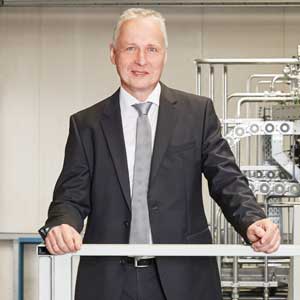 Dr Bodo Fink, CEO
While rare, such superlatives are justly warranted for WF Maschinenbau, a mechanical-engineering company rich in tradition, with future-oriented innovations in metal forming processes.
To begin with, WF Maschinenbau is in a class by itself when it comes to developing and manufacturing highly efficient forming machines. It is unique and truly stands out in the industry and the world for bringing more than four decades of rich experience to the table. While the global industry is replete with countless companies that build lathes, milling, and drilling machines to turn blocks of metal into the desired end form, their metalworking technologies produce metal chips and thus scrap during the production process. This directly translates into additional costs for their customers due to the material loss of the original preform.
This is where WF shines through with chipless metal forming. “Our machines produce the desired shape by maintaining the original weight and volume of the preform. There are only a handful of companies worldwide, five to be precise, that can flow-form metal into rotationally symmetric shapes without producing any scrap at all,” says Dr Bodo Fink, CEO of WF Maschinenbau. Besides, WF is the only machine builder in the world that has its own highly capable and dedicated R&D centre, where experienced application engineers work on their own and customer-specific developments. This R&D centre ensures that WF’s customers are equipped with a proven solution before making a cost-intensive investment into a new flow-forming machine. That’s not all; unlike most companies in this realm, WF also carries out process development for its customers, especially when it comes to new methods, approaches, and technology fields.
WF caters to customers globally across automotive, aerospace, energy, and environmental engineering and defence industries with best-in-class and high-quality machines manufactured in Germany. The product range covers machines for belt pulleys and torsional vibration dampers, hubs and face gear parts, rim rings, wheels and wheel disks, flow-turning and flow-forming parts, precision pipes, and high-pressure gas cylinders. WF machines employ individual or combined manufacturing processes of non-cutting material shaping within one machine or in a combination of several machines in manufacturing lines. These machines are powered by high-end technologies like edge treatment, hub spinning, pipe sealing, and necking-in, profiling, flow forming, and metal spinning. WF also ensures that the manufacturing processes pursue the common objectives of manufacturing workpieces, without using cutting processes like turning or milling and achieving maximum strengths and stability with the minimum use of material.

Our machines produce the desired shape by maintaining the original weight and volume of the preform
When it comes to catering to the specific needs of its automotive industry clients, WF empowers them to overcome two long-standing challenges: cost efficiency and sustainability. “In cooperation with our customers, we continuously design new drive technologies that, through weight reduction, help save energy and reduce carbon dioxide emissions. These weight savings always translate into savings in material usage; thanks to our technologies, they can often produce more cost-efficiently than their competitors,” adds Dr Fink. “We have developed various processes in which lighter wheels are made from less material and yet are more stable due to material consolidation (both weight-optimised aluminium and steel wheels).”
Within two years of development work together with a major German automobile manufacturer and Thyssen Krupp, WF has succeeded in developing an entirely new process for the production of constant velocity joints (also called CV joint) and has it registered for a patent. Multiple CV joints are built into the vehicle’s engine compartment, and now they can be produced with a material input of just 730 grams, which is 52 percent less than in the previous forging process.
In the field of electromobility, WF’s latest developments and achievements in engineering meet the need for high-performance vehicle parts for the electric drive to gain higher stability at a lower weight. WF also works closely with various companies and institutes to research on how the chipless flow-forming technology can be used in the aerospace sector. The first successes have been witnessed in the area of conical (rocket) outflow rings made of titanium alloys and the production of fuel tanks. “We are doing preliminary small-scale tests for the NASA for a new rocket fuel tank concept that will then be produced on a large scale,” reveals Dr Fink.
Fink also credits the success of WF’s to his 125-member strong team that brings in its profound know-how day-in and day-out and aims at offering the customers new, innovative processes and products. In doing so, WF closely cooperates with steel and material producers all over the world and also with renowned research institutes and universities to continuously optimise its machines. With over 70 different patents in its line of work, WF has no plans of slowing down and resting on its laurels. The company performs tests in its R&D centre to continuously improve and innovate future WF series machines as well as to develop customer-specific solutions.
While the automotive industry is foraying into the field of the fuel cell, WF’s machines are primed to manufacture gas cylinders from special aluminium alloys that would provide reliable and secure storage for highly volatile Hydrogen gas. Moving forward, WF is expanding its sites in the US and China to better (and faster) support its customers.
Company
WF Maschinenbau
Management
Dr Bodo Fink, CEO
Description
WF Maschinenbau has been developing and manufacturing highly efficient forming machines for more than 40 years. It is unique and truly stands out in the industry and the world for bringing more than four decades of rich experience to the table. WF Maschinenbau's machines produce the desired shape by maintaining the original weight and volume of the preform. There are only a handful of companies worldwide, five to be precise, that can flow-form metal into rotationally symmetric shapes without producing any scrap at all. WF is the only machine builder in the world that has its own highly capable and dedicated R&D centre, where experienced application engineers work on their own and customer-specific developments. With over 70 different patents in its line of work, WF performs tests in its R&D centre to continuously improve and innovate future WF series machines as well as to develop customer-specific solutions


Manufacturing Technology Insights Weekly Brief
Be first to read the latest tech news, Industry Leader's Insights, and CIO interviews of medium and large enterprises exclusively from Manufacturing Technology Insights
