

THANK YOU FOR SUBSCRIBING


Precision is not just a performance metric in modern manufacturing. It is a direct driver of competitive advantage, influencing yield, uptime and cost efficiency. HEIDENHAIN develops technologies that help manufacturers achieve tighter tolerances, reduce scrap and increase uptime, directly improving performance and cost outcomes.
The company supports industries where even the smallest deviation can affect yield, uptime and overall cost, including semiconductor manufacturing, automation, robotics, electrification and medical technology. In these environments, competitive performance depends on absolute precision and consistency. HEIDENHAIN ensures machines operate exactly as intended, even in complex and demanding conditions, maintaining consistency where variation translates into measurable loss.
Its approach is grounded in solving performance-linked challenges such as thermal expansion, high-speed data transmission and increasing automation complexity. Rather than positioning precision as a feature, HEIDENHAIN applies it as a system-level control mechanism that improves output consistency and reduces operational variability.
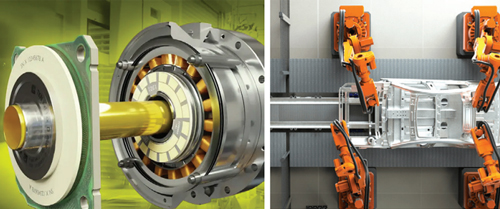 Core technologies such as encoders and CNC control systems operate as tightly integrated components within high-precision environments. Encoders deliver high-resolution position feedback under conditions such as temperature variation and contamination, while the TNC7 CNC control system uses this feedback to guide motion, improving repeatability and surface quality while reducing material waste. Single cable solutions such as EnDat consolidate power and data transmission, reducing system complexity and enabling faster real-time communication across machine components.
In semiconductor manufacturing, for example, even microscopic positioning errors can result in defective wafers and lost yield. By combining high-resolution encoder feedback with precise motion control, HEIDENHAIN systems help maintain consistent positioning, reducing defects and improving production reliability.
Integration That Drives System-Level Outcomes
How does HEIDENHAIN integrate measurement and control systems to optimize machine-level performance outcomes?
As automation increases, performance depends on how effectively measurement and control systems operate together. HEIDENHAIN connects these functions into unified architectures that optimize machine-level outcomes such as uptime, throughput and consistency rather than improving isolated components.
Its collaboration with robotics companies, automation integrators and semiconductor equipment manufacturers provides direct visibility into operational constraints. This ensures that system design reflects real-world performance requirements, not theoretical optimization.
Application-Specific Precision and Economic Reliability
Why is application-specific precision critical for maintaining reliability and reducing operational costs in manufacturing?
Application requirements vary across industries, but the economic impact of failure remains constant. HEIDENHAIN addresses this by aligning encoder and CNC control configurations to specific use cases such as robotic motion, wafer handling and medical device manufacturing, ensuring precision is maintained under application-specific constraints.
Reliability remains a key priority, especially in industries where downtime directly impacts production output and cost. HEIDENHAIN systems are designed for long-term operational stability with minimal maintenance, reducing failure rates, lowering operating costs and improving total cost of ownership.
As manufacturing systems become more connected, accurate data becomes essential for process control and optimization. HEIDENHAIN provides high-fidelity measurement data that integrates into digital manufacturing environments, enabling performance monitoring, process improvement and faster decision-making.
In what ways does high-fidelity data support digital manufacturing optimization and strategic decision-making?
HEIDENHAIN’s technologies operate at the core of systems where precision determines output economics. It supports manufacturers in maintaining a measurable competitive advantage while adapting to increasing operational complexity.
Company
HEIDENHAIN
Management
David Doyle, President and CEO
Description
HEIDENHAIN is a global leader in precision measurement and control technology, developing encoders, CNC controls and digital solutions for demanding positioning tasks. Its technologies enable high accuracy, reliability and digitalized manufacturing across industries such as semiconductors, automation, robotics and medical technology.

Manufacturing Technology Insights Weekly Brief
Be first to read the latest tech news, Industry Leader's Insights, and CIO interviews of medium and large enterprises exclusively from Manufacturing Technology Insights
